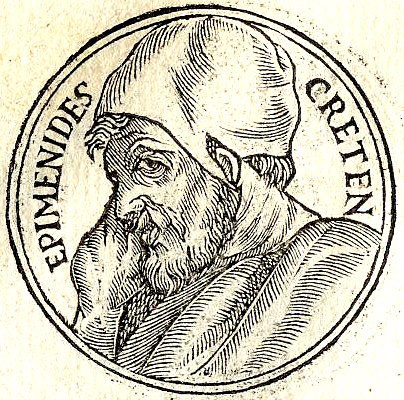
 A bust depicts the semi-mythical 6th century B.C. philosopher-poet Epimenides, whose infamous saying about Cretans “always lying” is quoted by St. Paul in a somewhat humorous fashion in his letter to Titus. St. Paul, who grew up ingrained in Greek culture, was known for using the customs of the day to teach instead about the Gospel of Jesus Christ. (Wikimedia Commons)
Not exactly the type of slogan you'd find in an advertisement for the Island of Crete! And you probably wouldn't expect to find this derogatory remark in Scripture, either. But guess what? It is Scripture. Paul says this to Titus in Titus 1:12. Well, actually, that isn't exactly accurate. This is not Paul's saying, but rather Paul is quoting a philosopher. Let me give you the full quote:
"One of them, a prophet of their own, once said, 'Cretans have always been liars, vicious beasts, and lazy gluttons.'"
The background to this quotation is actually quite entertaining and something of an inside joke. First, who is the philosopher? It is the ancient Greek philosopher and poet Epimenides of Knossos (6th or 7th century B.C.). The phrase is quoted by Callimachus (c 300–240 B.C.) in the first half of his Hymn to Zeus, applying it to the Cretan legend that the tomb of Zeus was on the island. The quote is:
“They fashioned a tomb for you, holy and high one, Cretans, always liars, evil beasts, idle bellies. But you are not dead: you live and abide forever, For in you we live and move and have our being.”
Paul quotes the last line to the Greeks at the Areopagus in Acts 17:22-28:
 Gary Michuta
“... 'You Athenians, I see that in every respect you are very religious. For as I walked around looking carefully at your shrines, I even discovered an altar inscribed, ‘To an Unknown God.’ What therefore you unknowingly worship, I proclaim to you. The God who made the world and all that is in it, the Lord of heaven and earth, does not dwell in sanctuaries made by human hands, nor is he served by human hands because he needs anything. Rather it is he who gives to everyone life and breath and everything. He made from one the whole human race to dwell on the entire surface of the earth, and he fixed the ordered seasons and the boundaries of their regions, so that people might seek God, even perhaps grope for him and find him, though indeed he is not far from any one of us. For ‘In him we live and move and have our being,’ as even some of your poets have said, ‘For we too are his offspring.’"
In a previous article, we noted that St. Paul grew up in a city named Tarsus. Tarsus was the ancient crossroad between the east and west, kind of like an ancient city of St. Louis. It had lots of commerce and it also was the center for stoic philosophy. Therefore, St. Paul was very familiar with pagan philosophy and had no problem pointing to Epimenides to open a conversation.
But did you notice in Titus 1:12 the unusual way Paul introduces his quote to Titus? He called the philosopher "a prophet of their own." What did he mean by "of their own?" Here is where things take a humorous turn. Epimenides of Knossos was from Crete! Therefore, Epimenides was making this derogatory remark, not only about his own people, but apparently about himself as well. Or did he?
Epimenides’ statement has become famous as the "Epimenides paradox." It is a "self-referential" statement. When the Cretan Epimenides wrote that "Cretans always lie," we run into a conundrum. Is the statement true or false? If it is true that Cretans "always lie," than Epimenides (a Cretan) must be lying about Cretans always lying. Cretans, therefore, do not always lie. If the statement is false and Cretans do not always lie, then Epimenides of Crete is lying by saying that they do. There are a number of ways out of this paradox, such as the statement not being a statement of fact, but poetic hyperbole or that the falsity of "always lying" does not mean that they always tell the truth.
What's funny is that Paul, who certainly knew this paradox, concludes by saying in the very next verse: "That testimony is true" (Titus 1:13). I can only imagine Paul having a smile on his face when he wrote that last line.
Gary Michuta is an apologist, author and speaker and a member of St. Michael the Archangel Parish in Livonia. Visit his website at www.handsonapologetics.com.