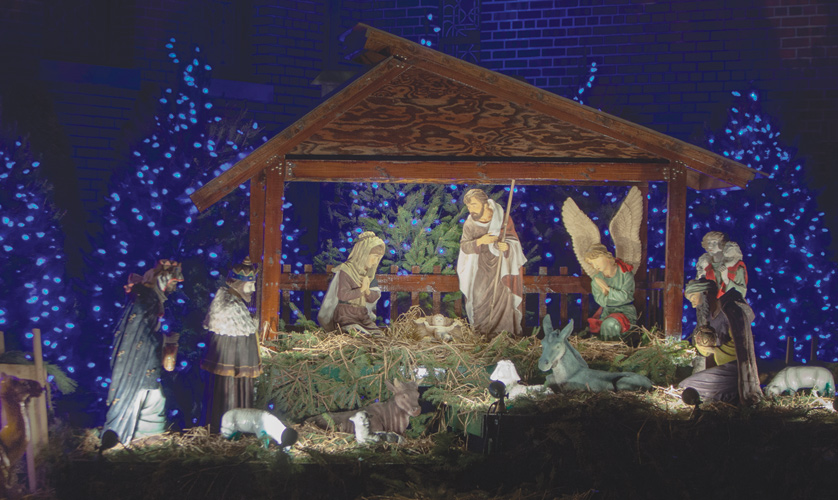
 A Nativity scene is displayed on Christmas on the grounds of of St. Francis of Assisi Church in Haskell, N.J. (CNS photo/Octavio Duran) (Dec. 27, 2013)
Since 2006, I’ve written six Christmas poems of a narrative nature: five of them recounting a different person’s experience of the first Christmas: Simeon (2006), the Blessed Virgin Mary (2008), our Lord Jesus (2009), the shepherds (2010), and St. Joseph (2013). The sixth was a diversion from the Christmas morning/biblical theme, but still narrative in form: about St. Nicholas (2012).
It has become a literary tradition (first-person, Bible- or Catholic tradition based poems) within a personal creative custom (my own Christmas poems, now numbering a dozen altogether) within a Christian liturgical celebration (Advent and Christmas). I’d like to present two of these: about the Blessed Virgin Mary and St. Nicholas. I hope you enjoy reading them as much as I have enjoyed writing all of these poems, and a blessed Advent and Merry Christmas to one and all!
 Dave Armstrong
Mary’s Carol
I was just a young, poor girl from Nazareth in Galilee; To Joseph betrothed; descended from King David’s line. Obedient to Moses’ and Yahweh’s holy laws were we; Seeking in all our ways and acts to follow the Will Divine.
The glorious angel Gabriel suddenly one day appeared: Speaking solemnly in troubling and confusing ways. With words causing great awe, confusion, even fear: Why hail me as “O favored one” and “full of grace”?
I was told that I was chosen to bear a special Son, A great man: the righteous “Son of the Most High.” Inheritor of David’s throne and higher than everyone; Reigning over Jacob, with His Father’s kingdom nigh.
The Holy Spirit was to “overshadow” me like a cloud; My precious child was all-holy; God’s only begotten.“What did that mean?”, I wondered; yet not out loud; Trembling, pondering a message not soon forgotten.
To Gabriel I said I was the lowly “handmaid of the Lord”; Whatever God wanted, I was happy and willing to do. I resolved to “let it be to me according to your word”; I embraced the luminous vision of God’s holy gospel anew.
I visited my kinswoman Elizabeth, in Judaean hills far away; The prophet John the Baptist did leap for joy in her womb.
He would prepare the way for Jesus on that wonderful Day: The healer of the blind, Who raised the dead from the tomb.
Elizabeth, filled with the Holy Spirit, praised this lowly maid; Calling me blessed among women, carrying a blessed child. I was even the mother of her “Lord,” — is what she said; I kept these things in my heart, astonished all the while.
Then my soul praised God: magnifying His name and deeds, Rejoicing that He saved me by grace from a certain fate. Marveling at how He had always filled His people’s needs, From generation to generation: Abraham up to that date.
The night I bore my Lord Jesus is always clear in my mind; No inn or house in sight; just a cold, dusty (but dry) cave. Even the beasts “understood,” and were so gentle and kind; The Lord of Lords was now with us, to seek and to save.
Angels sang of glad tidings; curious shepherds came to see — After hearing loud heavenly choruses of great peace and joy — The King of kings, David’s heir, and carpenter’s son of Galilee. God had become man: the eternal Creator was a baby boy!
Then I quietly meditated on the divine mission my child had; Though my soul be pierced; by His death we’d reach heaven. But I accepted this: God’s love and mercy made me so glad; For this divine plan my body and soul I have joyfully given.
(for the biblical background, see: Luke 1:26-56; 2:1-20,35)
St. Nicholas Speaks
My name is St. Nicholas; and from the 4th century I do hail;
I was Bishop of Myra, on the southwestern coast of Turkey.
I spent time in the Holy Land, and also in Diocletian’s jails;
Fought the Arian heretics at Nicaea, but my history is murky.
I was most known for helping the poor, under cover of night;
Dropping gifts down a chimney, landing in stockings drying.
I loved children and sailors: by grace aiding all whom I might;
Once multiplied wheat, to save many in a famine from dying.
My feast day is December 6: the day I departed this earth;
My relics still exude sweet myrrh-like rose water every year.
Christians around the world celebrate the day with great mirth;
Lots of stories of my life, young and old alike do annually hear.
I was named Nikolaos the Wonderworker due to many prayers
Answered often through my intercession, with miracles as well.
The Dutch called me Sinterklaas, adding on legends by layers;
They say I leave coins in wooden shoes; maybe so: I won’t tell!
The tales and fables grew through the centuries, far and wide;
Mostly in the countries where German and English are spoken.
As Christkindl or Kris Kringle: to Jesus’ holy name I was tied;
Now I’m often called Santa Claus: in long tradition unbroken.
In America my legend, through Washington Irving and others,
Spread in folklore, “Twas the night before Christmas,” and such.
Thomas Nast drew me as a jolly old soul, of all men a brother;
Of reindeer, North Pole, red suits, and elves were heard much.
At length, the fables became so secular, commercial, and obscure
That their initially Christian contents became shallow and hidden.
It’s not Santa who sees all and rewards children good and pure;
But God the Father: the source of all graces and gifts we’re given.
Jesus dying for us gave life such deep meaning and hope;
I am His messenger, spreading His gospel of salvation and peace.
Without His sustaining power and love, none of us could cope;
This joy of Christmas, till the end of the world will never cease.
To read my ten other Christmas poems and other related “seasonal” papers and links, simply Google “Christmas (Index Page for Dave Armstrong)”.
Dave Armstrong has been a full-time Catholic apologist since 2001. He lives in Melvindale, grew up in Detroit, and attends St. Joseph Church near downtown. He has been happily married to his wife Judy since 1984, and they have four children. Dave has written 44 books on various apologetics topics, including five for Sophia Institute Press, and several bestsellers in the field. These are available for purchase (ePub, mobi, or PDF) at his deep discount booksite, www.biblicalcatholicism.com, and in paperback elsewhere.