

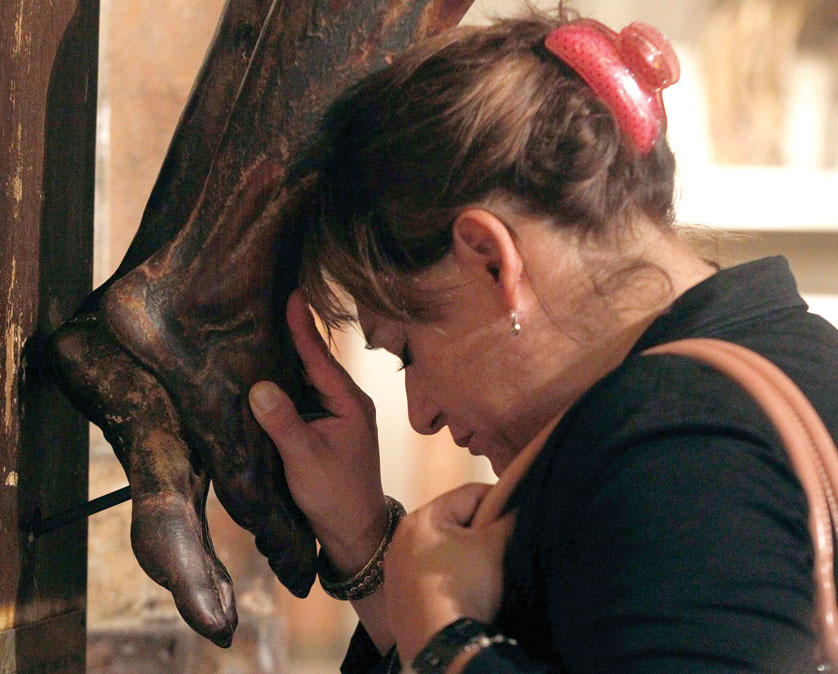
 A woman prays at the foot of a crucifix during a Mass at the metropolitan cathedral March 13 to commemorate the first anniversary of the election of Pope Francis. (CNS photo/Enrique Marcarian, Reuters) (March 14, 2014)
Shusaku Endo’s novel Silence depicts a type of psychological brutalization practiced during 17th-century Japanese persecution of Christians, in which priests were told that their apostasy would save other captured Christians from torture. At the novel’s climax, a Jesuit missionary, who has already apostatized under these conditions, tells a fellow Jesuit now given the same alternative: “Christ would certainly have apostatized to help men … Now you are going to perform the most painful act of love that has ever been performed.”
 Sr. Maria Veritas Marks, OP
The statement prompts us to consider what love actually is. In our culture, love is often seen as sparing the other pain. And there is truth to this. We should indeed pour our energies into curing disease, comforting the afflicted, freeing those held captive either bodily or mentally. Christ’s merciful heart was wrenched at the sight of both physical suffering and spiritual ignorance and confusion. The sick came thronging to Him, “and He cured them all” (Mt. 12:15). Again and again, He sundered the shackles of sin: the paralytic on his mat, the adulteress, the woman with seven demons, the Samaritan at the well. Jesus wants us to live free.
But Jesus did not always spare people pain. Mary stood at the foot of His cross in agony, and He did not come down from it. He foretold rejection and persecution for His disciples and discord within households where some believed in Him and some did not. The adulteress and the Samaritan woman would have to “sin no more,” which probably meant years of struggling to break sinful habits.
Sometimes, Christ’s refusal to offer immediate help in a situation led to greater triumph. The Syrophoenician woman begging for her daughter’s healing responded with now-famous wit and determination when Christ told her His power was meant, at least for the time being, for the Jews alone: “Even the dogs under the table eat the children’s scraps,” she said (Mk. 7:28). Her tenacity in the face of Christ’s rebuff wrung from Him the joyous exclamation, “Oh woman, great is your faith!” And the healing of her daughter.
Christ did not come when His friends Martha and Mary urgently summoned Him to heal their brother Lazarus. But after Lazarus died and they contended with bitterness, grief, and, likely, a sense of betrayal, He worked a miracle greater than Lazarus’ cure: Lazarus’ resurrection.
Every time we make the sign of the cross, we profess, in faith, something scandalous: that suffering is not the greatest evil. Rather, suffering is an evil that, borne in love, miraculously becomes life-giving. We must understand fully and embrace this scandal, the scandal of the seed that must fall into the ground and die in order to bear fruit (Jn. 12:24). Otherwise, we will find ourselves betraying Love in the name of love.
Sr. Maria Veritas Marks is a member of the Ann Arbor-based Dominican Sisters of Mary, Mother of the Eucharist.