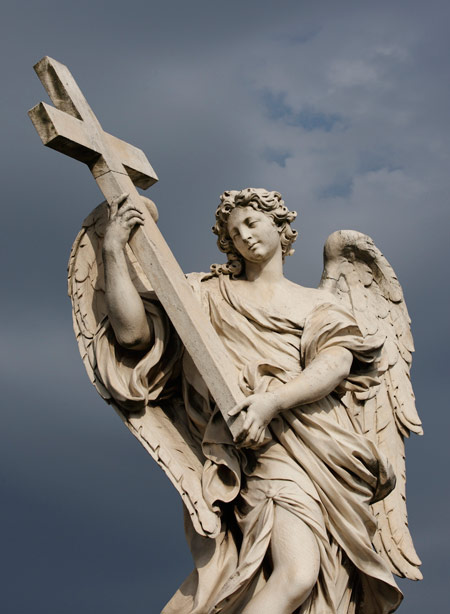
 A statue of an angel carrying Christ's cross is seen on the Castel Sant'Angelo bridge in Rome May 12. The 10 angel statues on the bridge each carry an element of Christ's passion. The statues were designed by Gian Lorenzo Bernini and executed by his students in 1688. (CNS photo/Paul Haring) (July 28, 2010)
The veneration of both the heavenly angels as well as saintly men and women who have fulfilled God’s will is fully embedded within our Catholic tradition. Nevertheless, it is often strongly contested by our Protestant brethren. So, continuing our examination of the biblical support for such Catholic traditions, we ask: How does the Bible present such veneration?
Take Abraham’s reaction to his heavenly visitors in Genesis, for instance:
Genesis 18:1-2, 22 (RSV “And the LORD appeared to him by the oaks of Mamre, as he sat at the door of his tent in the heat of the day. He lifted up his eyes and looked, and behold, three men stood in front of him. When he saw them, he ran from the tent door to meet them, and bowed himself to the earth, ... [22] So the men turned from there, and went toward Sodom; but Abraham still stood before the LORD.”
The text in between goes back and forth interchangeably, referring to “men” or “they” or “them” (18:9, 16) and “The LORD” or a first-person address from God (18:10, 13-14, 17-21). But there are three men here; they can’t all plausibly be God. The same two angels (18:22) then encounter Lot, who venerates them:
Genesis 19:1 “The two angels came to Sodom in the evening; and Lot was sitting in the gate of Sodom. When Lot saw them, he rose to meet them, and bowed himself with his face to the earth…”
They distinguish themselves from God in Genesis 19:3 (“the LORD has sent us to destroy it”).
 Dave Armstrong
Who is ‘the angel of the Lord’?
Another fascinating motif in Scripture is “the angel of the Lord,” who is sometimes referred to as God Himself; other times as His direct representative. In one passage (Judges 13:15-22), we see reference to God (13:16, 19, 22), but also to the angel of the Lord as His direct representative (13:15-18, 20-21 and in the larger passage, 13:3, 6, 9, 13). The angel is honored (v. 17), they fall on their faces to worship (v. 20) and at length the angel is equated with God as His visible manifestation (v. 22). But the difference between the angel and God is highlighted by the angel being described as a “man of God” (13:6, 8) and “the man” (13:10-11).
Elsewhere, the angel of the Lord is equated with God (theophany) in Genesis 31:11-13 and Judges 2:1, but differentiated from God as well, as a representative (2 Sam 24:16; 1 Ki 19:6-7; 2 Ki 19:35; Dan 3:25, 28; 6:23; Zech 1:8-14). Even with Moses and the burning bush, there is a reference to “the Angel of the Lord” (Ex 3:2) and yet two verses later, “God called to him out of the bush.”
With this background in mind, let’s look at two passages in Revelation that Protestants bring forth as an argument against all such veneration:
Revelation 19:10 “Then I fell down at his feet to worship him, but he said to me, ‘You must not do that! I am a fellow servant with you and your brethren who hold the testimony of Jesus. Worship God.’ ...”
Revelation 22:8-9 “... I fell down to worship at the feet of the angel ... but he said to me, ‘You must not do that! I am a fellow servant with you and your brethren the prophets, and with those who keep the words of this book. Worship God.’”
I contend that St. John (caught up in the moment) mistakenly thought this was a direct manifestation of God, but was corrected by the angel. After all, Jesus had appeared to him earlier in the book, and when He saw Him, he “fell at his feet as though dead” (1:17; cf. 1:10-20). We also know that the post-Resurrection Jesus was not recognized for Who He was, several times (cf. Lk 24:16, 31; 36-39; Jn 20:14-18, 21:4). Both St. Augustine and St. Athanasius also believed John thought the angel was Jesus, and so desired to adore or worship.
Worship vs. veneration
We see angels bowed to (venerated) elsewhere in the New Testament, with no rebuke at all:
Luke 24:4-5 “While they were perplexed about this, behold, two men stood by them in dazzling apparel; [5] and as they were frightened and bowed their faces to the ground, the men said to them, ‘Why do you seek the living among the dead?’”
The prophet Daniel venerates an angel (seemingly Gabriel: see v. 16) without “controversy”:
Daniel 8:15, 17 “When I, Daniel, had seen the vision, I sought to understand it; and behold, there stood before me one having the appearance of a man. ... [17] So he came near where I stood; and when he came, I was frightened and fell upon my face. But he said to me, ‘Understand, O son of man, that the vision is for the time of the end.’”
In several other instances, men are also bowed down to and venerated, with no disapproval in the text; for example, Paul and Silas (Acts 16:29) and Daniel (Dan 2:46-48; by the king!). The Greek word for “fell down before” in Acts 16:29 is prospipto. It is also used of worship of Jesus in five passages (Mk 3:11; 5:33; 7:25; Lk 8:28, 47). But where men are involved, the meaning is honor, or veneration.
Note that the word “worship” doesn’t appear in any of the passages here in favor of veneration. When “worship” does appear in connection with a man or angel, it isn’t permitted:
Acts 10:25-26 “When Peter entered, Cornelius met him and fell down at his feet and worshiped him. [26] But Peter lifted him up, saying, ‘Stand up; I too am a man.’”
We see the same “category mistake” in Revelation 19:10 and 22:8-9, and also when men thought that Paul and Barnabas were Zeus and Hermes and “wanted to offer sacrifice.” They were rebuked, as mistaken (Acts 14:11-18).
Therefore, based on all this, we conclude (as Catholics always have) that worship and adoration is reserved for God alone, while veneration or honor is to be offered to the holy angels and worthy, saintly men.
Dave Armstrong has been a full-time Catholic apologist since 2001. He lives in Melvindale, grew up in Detroit, and attends St. Joseph Church near downtown. He has been happily married to his wife Judy since 1984, and they have four children. Dave has written 44 books on various apologetics topics, including five for Sophia Institute Press, and several bestsellers in the field. These are available for purchase (ePub, mobi, or PDF) at his deep discount booksite, www.biblicalcatholicism.com, and in paperback elsewhere.