
 A bird is seen landing on a tree at sunset in 2014 in Cape Town, South Africa. "All African nations are contributing less to the total harmful emissions and are the most affected by climate change," Egyptian President Abdel Fattah el-Sisi said at the U.N. climate conference in Paris. (CNS photo/Nic Bothma, EPA) See AFRICA-CLIMATE-EXPECTATIONS Dec. 4, 2015.
In his 1989 book Real Presences, literary scholar and critic George Steiner makes a provocative point: we are more often in contact with the secondary than with the primary. By this, he means that we more often read about a famed painting than actually see it in person, peruse a review of a concert than listen to the music, assimilate someone’s opinion of King Lear than attend the play itself. While the phenomenon is not blameworthy, it might become so, Steiner suggests, if we use the secondary to shield ourselves from the demands of the primary, particularly its moral demands.
Great works of art can require that we change our lives; insofar as they portray truth and beauty, they serve as gateways to God. As St. John Paul II wrote in his Letter to Artists, “Every genuine artistic intuition goes beyond what the senses perceive and, reaching beneath reality’s surface, strives to interpret its hidden mystery … Beauty is a key to the mystery and a call to transcendence … That is why the beauty of created things can never fully satisfy. It stirs that hidden nostalgia for God” (§§6, 16).
As I was pondering these insights one morning, I glanced out the window and witnessed a perfect illustration of remoteness from reality, albeit one Steiner in 1989 had not experienced. The sun was warming swathes of grass and illuminating fall leaves dappled red, orange, yellow and green against a blue sky; in the midst of this autumnal glory, a student strolled oblivious, his head bent over his phone. The moment would never come again, that morning, that sun, those leaves. Yet all the while, the student’s eyes and thoughts inhabited a distant world.
In the spiritual life, I am often, metaphorically, the young man bent over his cellphone. God is always present, but I can hide from Him, from the joy or the suffering that He places before me in a particular situation, from the person who needs my attention. We all have our preferred distractions, and sometimes even the stress or the busy-ness that we bemoan is actually our convenient buffer against His knocking.
Steiner is not a believer, but the title of his book, Real Presences, gestures toward the One who is “really present,” both in the Eucharist and to our hearts on a moment-by-moment basis. St. Paul discourses profoundly on the divine intimacy to which we are called in Christ: unlike the Israelite people, who begged Moses to veil the divine radiance
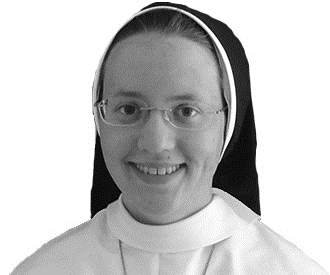
 Sr. Maria Veritas Marks, OP
emanating from him after his conversations with God on Mount Sinai, we are invited and challenged to a face-to-face encounter. This meeting is the heart of the Christian life: “All of us, gazing with unveiled face on the glory of the Lord, are being transformed into the same image from glory to glory” (2 Cor 3:18).
Sr. Maria Veritas Marks is a member of the Ann Arbor-based Dominican Sisters of Mary, Mother of the Eucharist.