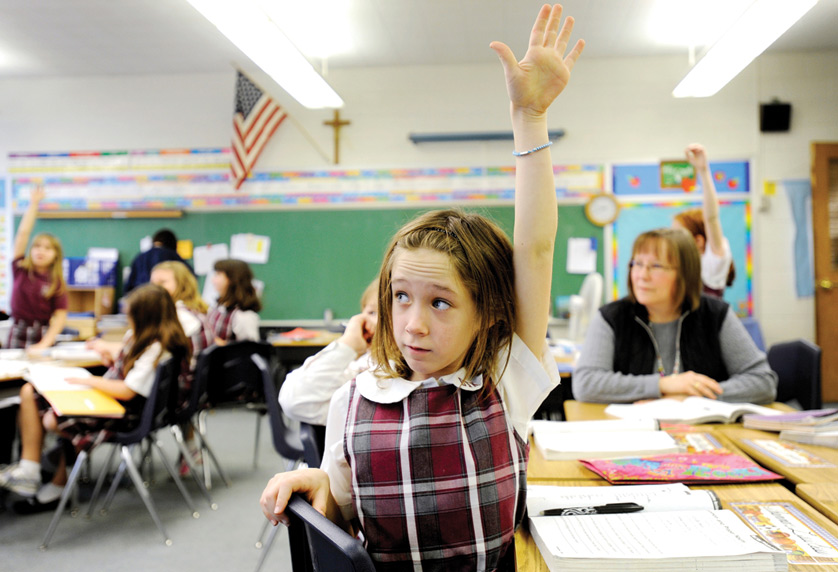
 A fourth-grader raises her hand to answer a question at Christ the King School in Irondequoit, N.Y., in this 2011 photo. Even with school out for the summer, the debate is ongoing about the love-them-or-hate-them Common Core State Standards, developed by the National Governors Association and the Council of Chief State School Officers. (CNS photo/Mike Crupi, Catholic Courier) (July 18, 2014) See WASHINGTON LETTER July 18, 2014.
“We already learned this last year,” is a common line from my middle school students. If I am honest with myself, I can spot the same attitude in myself: it can be a temptation to think of myself as the one imparting knowledge and to forget that I still have much to learn as well.
The virtue of docility is a “willingness to be taught.” How ready are we to learn from another? It takes a great deal of humility to realize that I do not know everything and that I can learn something even from the fallen human being next to me. Think of the Child Jesus. The Bible tells us that, “He grew in wisdom and understanding” (Luke 2: 52). Christ was willing to learn not only from His sinless Mother, but also from His imperfect foster father, St. Joseph. If God Himself was willing to learn from a mere man, who are we to be too proud to learn what He wants to teach us through others?
 Sr. Mary Martha Becnel, OP
I began the school year by teaching my students about docility, hoping they would cultivate an openness to learning from both teachers and parents during the year. As the year has progressed, I have found this lesson applicable to my own life as a teacher: again and again, my students have taught me important lessons; or rather, God has used them to show me ways He wants me to grow, even though that is generally not what my students intend. It takes humility to be docile enough to learn even from those over whom one has authority. But it also takes faith to realize that it is God who is at work.
God speaks to us and is present to us in the everyday circumstances of our lives. Of course, He teaches us directly by His Word and by the teachings of the Church, but He also teaches us through the people He has put into our lives. A friend who needs to talk, a child who needs help with homework, the dishes that need to be done — these are all indicators to us of God’s will for us in the practical moments of our lives. And these everyday events are the way that He teaches us, showing us how to grow in holiness and in concrete love of His will and of those He loves. May we be open this year to recognize Him at work in our daily lives and to learn all that He wants to teach us through others.
Sr. Mary Martha Becnel is a member of the Ann Arbor-based Dominican Sisters of Mary, Mother of the Eucharist.