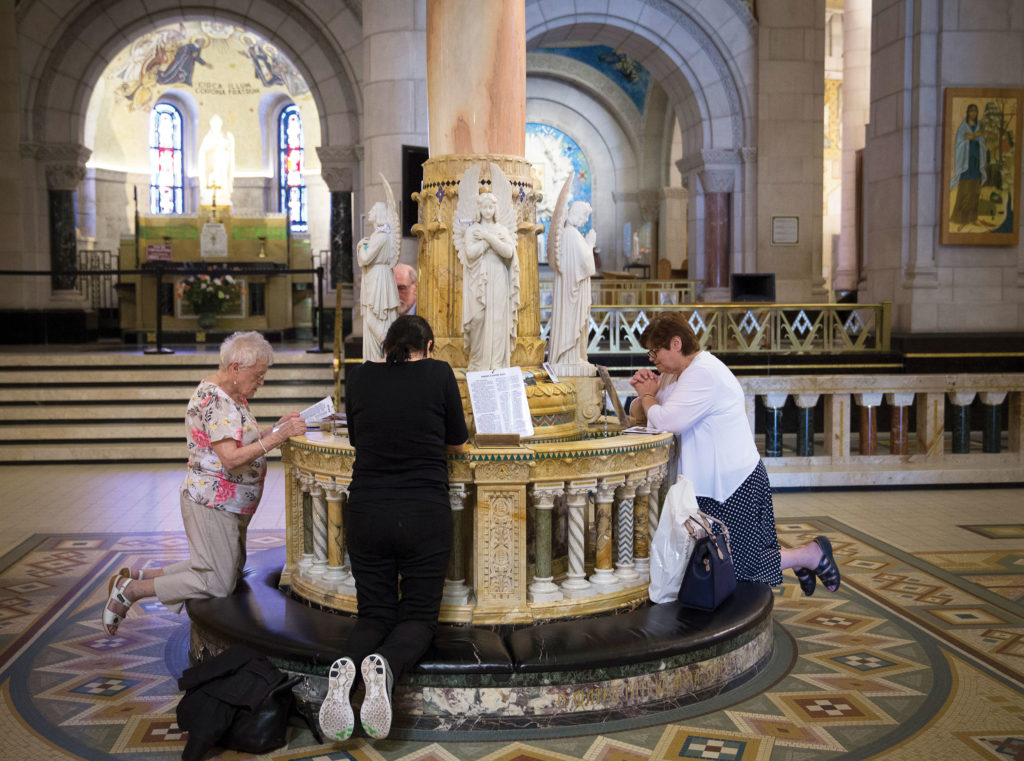
 Pilgrims pray June 24 at the Basilica of Ste.-Anne-de-Beaupre in Ste.-Anne-de-Beaupre, Quebec. Initially a shrine to honor St. Anne, mother of Mary, the basilica is considered an important Catholic sanctuary and receives about a half-million pilgrims each year. (CNS photo/Chaz Muth) See AMERICAN-PILGRIMS-ANNE-BEAUPRE July 31, 2017.
We call these doctrines that all Catholics must accept de fide dogmas (or in some cases, ex cathedra). In a nutshell, though there are fine (sometimes very fine) distinctions that can be drawn, the Catholic is obliged, in the nature of the case, to accept all that the Church teaches.
It’s an act of faith to accept the notion that the Catholic Church is the one true Church established by Jesus Christ, historically continuous, universal, specially protected by the Holy Spirit for the purpose of passing down the apostolic deposit.
Because we accept this in faith as Catholics, it is required that we accept all that the Church teaches. To do that is itself a result of supernatural grace from God.
Protestants don’t look at it that way because, first of all, they deny that the Church is infallible. Once one does that, then it is a completely new rule of faith. For Protestants, this rule is sola Scriptura, or the idea that Scripture (excluding an infallible Church and tradition) is the only infallible authority.
Therefore, it is very difficult for a Protestant to accept the notion of submitting to a Church’s teaching in faith, because for them, no Church has it completely right: only the Bible does that. They often see this as virtually a violation of people’s right to think for themselves or contrary to one’s conscience.
It’s not at all: it is a recognition of our own limitations, of something higher than ourselves — established by God, and of a Christian faith that includes acknowledgment of an authoritative, infallible Church. It takes faith, and faith is a supernatural gift granted by God through His grace and the assistance of the Holy Spirit. It’s not mere reason, but can be supported by reason: like all Christian dogma.
Some Protestants use the word “dogma,” but they generally prefer the word “doctrine.” Protestants, to the extent that they are serious about historic Christian doctrine, do, of course, require a set of beliefs, too: just not as many as we do. I always use the example of Calvinists. A truly Calvinist denomination (Presbyterian, Reformed, in their traditional forms and belief-structures) would not allow a member to deny all five tenets of what’s known as TULIP, which stands for 1.) Total Depravity, 2.) Unconditional Election, 3.) Limited Atonement, 4.) Irresistible Grace, and 5.) Perseverance of the Saints.
Even disbelief in two or three would not be permitted. They would no longer be considered members of the denomination, in terms of adherence to the creed of the group.
There are always, it’s true, people who join groups but disagree on some of the tenets. Catholics are not literally disallowed to have doubts and uncertainties in their head (the Church is not simplistic or naive about such things), but they are supposed to accept in faith all that the Church teaches, and certainly not openly oppose it, whether they fully understand everything or not.
As an analogy from my Protestant days, I attended Assemblies of God for four years (1982-86). I never agreed with one of the denomination’s “16 Fundamental Truths” — namely, that everyone had to speak in tongues in order to receive the “enduement of power.”
This I felt to be expressly contrary to Paul’s teaching about tongues, in which he says that not all speak in tongues (1 Cor 12:30). Because of this, I never became a member. I was simply being honest, saying in effect, “I don’t accept all 16 Truths that I am supposed to accept, so I won’t become a member, but I agree with most everything else taught.”
So what are we to do when we disagree with something in the church we attend? If we say we are Catholics, we do not reserve the right to express private judgment in dissent against the Church, and for good reason: as Catholics, we believe the deposit of faith entrusted to the Church has been passed down from the apostles through our Lord himself, safeguarded from error and taught for the benefit of all.
The Catholic Church doesn’t expect everyone to have perfect faith or knowledge and to fully understand every jot and tittle. But the Church expects a humble submission to that which has been established and held from the beginning (with development of doctrine and increased understanding along the way).
There are always, despite all these considerations, people who are “in” a group but not totally “of” it. Many times, they don’t properly understand the teachings of their own group. Other times, they do fully understand, and disagree, as I did in the Assemblies of God. I did what I felt was the only honest thing, and did not ever become a member, because that would have entailed ostensible agreement with a tenet that I did not accept. It would have been dishonest. One must understand what a group officially teaches.
To make this concept of “accepting all that the Church teaches” fairly simple and practical, Catholics are not at liberty to disagree with, for example, what is included in the Catechism of the Catholic Church. It was promulgated under Pope St. John Paul II in 1992, accompanied by the Apostolic Constitution Fidei Depositum, which stated in part:
“The Catechism of the Catholic Church, which I approved 25 June last and the publication of which I today order by virtue of my Apostolic Authority, is a statement of the Church’s faith and of catholic doctrine, attested to or illumined by Sacred Scripture, the Apostolic Tradition and the Church’s Magisterium. ...
“This catechism is given to them that it may be a sure and authentic reference text for teaching catholic doctrine and particularly for preparing local catechisms.”
 Dave Armstrong
Dave Armstrong has been a published Catholic apologist since 1993 and webmaster since 1997. He lives in Allen Park, grew up in Detroit, and is a member of Mother of Divine Mercy Parish near downtown. He’s been happily married to his wife Judy since 1984, and they have three sons and a daughter. Dave has written or edited 48 books on apologetics, including several bestsellers. If you’d like to help keep his influential teaching apostolate going as a much-needed monthly supporter, write to Dave at [email protected].