Detroit — That first car ride into the city of Detroit still stands out to him. His dad was driving.
Young Don Hanchon, hailing from the mostly white city of Wayne, said he’d known “one or two” black classmates at St. Mary School.
But entering Sacred Heart Seminary High School in Detroit after the eighth grade, he would now live in an area that was predominantly black. And it was something unmistakable on his ride into the city.
It wasn’t the choice of every student who came there to immerse themselves in a new culture — but for Hanchon, that drive to the seminary was the first in a long string of experience he would have that would anchor him into a community different from the one he’d known.
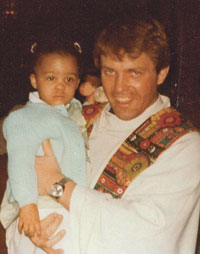
Throughout his priesthood, Bishop Hanchon has been known as a unique breed of priest who has gravitated toward minorities. From his very first assignment as associate pastor at the Cathedral of the Most Blessed Sacrament, to his current, decade-long assignment as pastor of the largely-Hispanic Holy Redeemer Parish in Southwest Detroit, he says he’s always felt right to be concerned with those who often are singled out.
“God put the desire in my heart to be with people who are different than I am,” Bishop Hanchon says. “And I’ve gotten so much in return. I am in so much debt for that, there’s no way I could repay it.”
Civil rights era
The sentiment was unmistakably fostered at Sacred Heart.
Bishop Hanchon’s memories there include marching down Linwood Ave. with the faculty and staff to Grand River Ave. downtown to protest the racial inequality in Selma, Ala.
“That was a key moment in my life,” he says. “I felt, ‘Yeah — we’re doing the right thing.’”
In his college years at the seminary, following the assassination deaths of Martin Luther King, Jr., and President John Kennedy, he recalls the army tanks rolling down Grand River, after the start of the Detroit riots in 1967.
“We were living two blocks away from where they started,” he says. “That was literally trial by fire during the summer … It can’t help but change you.”
But through it all, the seminarian Donald Hanchon was by no means just a witness to national occurrences — he involved himself locally in trying to bridge racial divides.
He recalls helping at Camp Hightower, an inner-city summer camp for minorities that was part of President Lyndon Johnson’s poverty program. Held on seminary property — and named due to the seminary’s tower — he got to know children from the city.
He also became a chaperon for what he called a teen panel on race — a group of black and white students who would travel together and make presentations to schools on racial harmony.
“I got deeper into it and I found what young people were thinking about it, and how a young black male felt when he was in an all-white situation,” Bishop Hanchon says. “I kind of got an inside look.”
Into the priesthood
He carried his affection for inner-city work into his priesthood, from the very start.
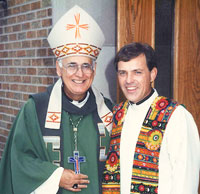
Looking at post-ordination assignments, he chose to apply at the Cathedral of the Most Blessed Sacrament. Although he didn’t like the idea of all the ceremony that surrounds the cathedral, he said he soon found out it was perfect for him.
“Beside this highfalutin world of bishops and ceremonies, there really was a parish,” he says. “I just learned so much. I found myself just thanking God for the intuition, for the desire, and for putting the right people there along the way. “
One of those people was the cathedral’s rectors at the time, the future Bishop Walter J. Schoenherr, who Bishop Hanchon says was one of the most influential characters in his ministry.
He recalls particularly an instance when Bishop Schoenherr “saved his life.”
Noticing that the young associate was burning himself out by working too hard, Bishop Schoenherr gave him something to think about.
“He said, ‘If you keep up this pace you’re on, I’ll give you 10 years,’” Bishop Hanchon recalls. “He said, ‘You’re either going to be dead, or out of the priesthood, or at Mercywood Hospital.’”
The young Fr. Hanchon took that advice to heart, and started seeing his priestly life as a marathon, rather than as a sprint.
The Hispanic call
Over the years of his priesthood, Bishop Hanchon established himself as a white priest lovingly in step with the black community in Detroit. He was made pastor of St. Mark Parish in Warren in 1979 and then administrator of St. Bernard Parish back in the city in 1981, at the same time he was made director of the archdiocesan vocations office.
But in 1987, his life and ministry would take a different turn.
The archdiocese was in need of more priests to speak Spanish, so Fr. Hanchon volunteered to spend the better part of a year down in Mexico and in Texas learning within the Hispanic culture.
His seminary classmate and good friend Msgr. Halfpenny, remembers the stories Bishop Hanchon would tell of his time in Mexico. Then-Fr. Hanchon lived with a family in Mexico a long distance from where he went to school. He didn’t have a car, but a motor scooter.
“So he used to ride this motor scooter from this family’s house to the school, and the dogs would chase him,” Msgr. Halfpenny says. “I think he may have gotten bit more than once or twice — but that’s the price he was willing to play … to be in Mexico and to live with a family and learn Spanish.”
His toils certainly put him in a different place when he came back to the Detroit archdiocese.
Upon his return to the area in 1987, he was appointed pastor of St. Joseph Parish in Monroe, which had an Hispanic population. Five years later, he was moved to the largely-Hispanic St. Gabriel Parish in Southwest Detroit and also made coordinator for Hispanic ministry in the Archdiocese of Detroit.
That led to his most recent pastorate at Holy Redeemer Parish, the archdiocese’s largest Hispanic parish.
‘Deeply touching’
Over the past 25 years, Bishop Hanchon says being with the Hispanic community has been among the greatest blessings of his life.
He speaks fondly of the deep spirituality he’s found in the community.
“If you’re ever here on a December 12 in the morning, on the feast of Our Lady of Guadalupe,” he says, speaking at Holy Redeemer Church. “You’ll see the church just packed, and everyone wants to bring up a rose and put it in front of Our Lady. And the singers want to sing a song to her, a love song, like she was their sweetheart.
“It just touches me so deeply, I can’t find words. The peoples’ faith is so real.”
Hispanic Catholics in the area reciprocate their thanks for Bishop Hanchon, too.
Sr. Consuelo Alcala, SSJ, has known Bishop Hanchon since he was pastor of St. Gabriel. Over the years, he became a part of her Hispanic family — especially in his care for her mother, who was from Mexico and who passed away at the age of 110 in 2005.
“He relates very well with the Hispanic people, and he gets very involved,” Sr. Alcala says. “He really puts his whole heart and soul into it. And I find him a very spiritual person, and I think that’s what connects to us.”
Bishop Hanchon’s work on behalf of the Hispanic community has included speaking up for the rights of immigrants, and also advocating for the presence of more Hispanic Church leaders. He was among the most grateful to have had Bishop Daniel Flores in Detroit from 2006 until early 2010, and even before Bishop Arturo Cepeda was named, he had voiced his desire to have another Hispanic-born bishop in the archdiocese.
Upon his being announced the next auxiliary bishop for Detroit, Archbishop Vigneron said Msgr. Hanchon has always stood out for his work among minorities.
“He’s very highly respected by all of the priests, and everybody would say he’s one of the outstanding pastors in our archdiocese,” Archbishop Vigneron said. “He’s always been in solidarity with people on the margins.”