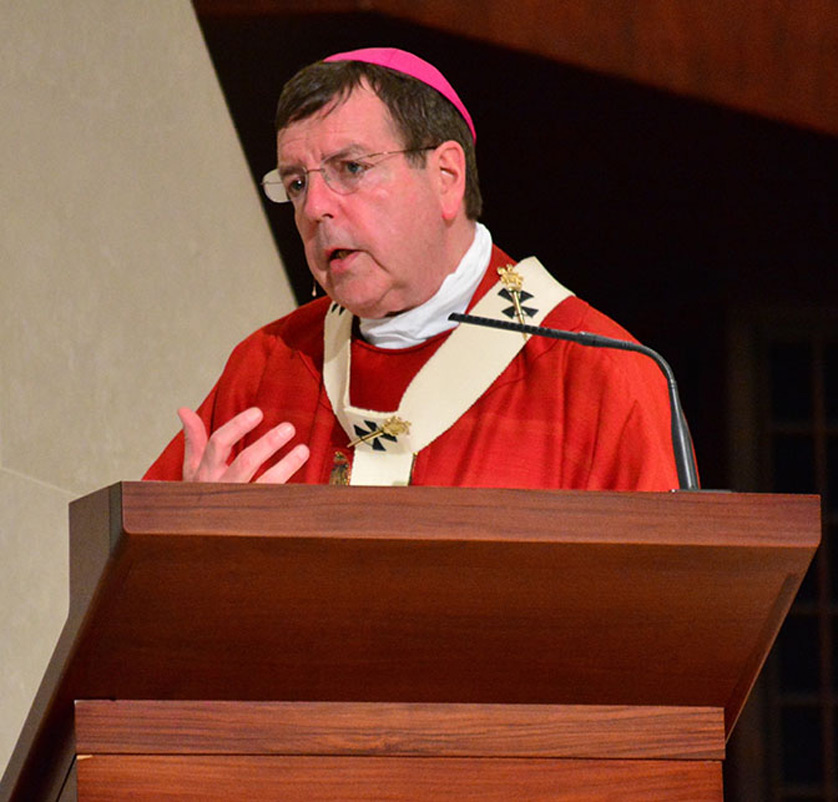
 Archbishop Vigneron preaches May 23 during a Pentecost vigil Mass at the Cathedral of the Most Blessed Sacrament.
Detroit — As the Archdiocese of Detroit concludes a Year of Prayer for a New Pentecost and launches forward with preparations for a fall 2016 archdiocese-wide synod on the New Evangelization, Archbishop Allen H. Vigneron and Auxiliary Bishop Michael J. Byrnes, whom the archbishop tasked with leading efforts geared toward evangelization, each sat down to answer questions about what the coming months — and years — will bring. Archbishop Vigneron’s responses are printed below, while Bishop Byrnes answers will be printed in the coming issues. Some responses have been abbreviated for space.
Q: What is the nature of the evangelization initiative that’s about to kick off in the Archdiocese of Detroit?
ARCHBISHOP VIGNERON: The evangelization initiative is our particular way in the Archdiocese of Detroit to respond to the call of St. John Paul II, Pope Benedict and now Pope Francis that we become a church of missionary disciples, the people of God on mission. In different dioceses, bishops are leading in different ways. Our effort here is over several years. We’ve ended a Year of Prayer for a New Pentecost, and now we’re going to have a year of preparing for a synod, and that year is going to be about education and formation with an emphasis that it’s a time for us to be evangelized so that we hear the Gospel anew and can understand what God wants from us.
Then we’re going to move into a synod, which is a way to bring the whole diocese together to think about what is our missionary vocation. Particularly what I want the members of the synod to think about is what we need to do to change the DNA of the archdiocese so we don’t simply think in terms of the old paradigm of maintaining institutions, but how do we at the very core of all we are think about being on mission and being missionary disciples.
Q: What is the urgency behind this New Evangelization we hear so much about?
ARCHBISHOP VIGNERON: I think the Holy Fathers, the popes, have given us this term to help us think about a time when there are whole nations, whole communities that once were shaped by the Gospel, but that’s not the case anymore. The New Evangelization could also be called the “renewed” evangelization. It’s not a new Gospel, but it’s about recognizing that we live in a new missionary time. We didn’t used to think about Detroit as missionary territory. But now we do, and that’s what makes it a New Evangelization. Blessed Paul VI saw how things were going, and the Holy Spirit moved him to speak up and say “We have to do things differently.” This is a different world. We’re in a post-Christian society where we’ve spent our heritage capital, and now we have to go back and start over.
Jesus said, “I came that they might have life, and have it to the full.” People aren’t going to be able to take hold of that life if we don’t announce that it’s offered in Jesus. It’s important because it’s what Jesus asked of us. It’s why he came. He came to bring the Good News. He started the Church so the Church could continue that work. Because God wants His world back. The Good News is that He loves this world and wants everybody to belong to His family.
Q: Who are we speaking to, primarily? Fallen-away Catholics? Non-Christians? Those with no faith background? Or all of the above?
ARCHBISHOP VIGNERON: I think it’s everybody, but it is helpful to think about the different groups you mentioned. We’re speaking to people who come to Mass every Sunday and are quite fervent in their faith, but we all need to hear the Gospel afresh and ensure our ardor is strong. It’s certainly about people who are tepid in their membership in the Church, who identify as Catholic but they don’t come to Mass every Sunday. Their identity with the Church is quite weak, and they need to be evangelized anew. And then, there are especially the “nones,” people who claim no religious affiliation. We have to address the New Evangelization to them as well.
Q: Intercessory prayer was a key component of the Changing Lives Together campaign, and it’s been successful. What role will intercessory prayer play in this initiative?
ARCHBISHOP VIGNERON: It’s already played an important role. That’s why we took a whole year to pray for the New Pentecost. We all have to be engaged in asking God and interceding with God for the gifts of the Holy Spirit. Because we can’t do this on our own. Some people are going to make a very particular contribution. Among all the gifts God gives them, this might be the most important thing they can offer, to be intercessors and beg for these graces for the New Pentecost. And we’ve organized ourselves to make sure we have a specific articulated role for that intercession.
Q: A synod is a big deal. Tell us a little about what to expect in 2016.
ARCHBISHOP VIGNERON: A synod is a very big deal, and it’s in part like a planning process, but it’s also a spiritual gathering of the Church. Not everybody in the diocese will be members of the synod, but everybody will participate in the preparations. In the life of the Church, from the very earliest centuries, a synod has been a way of “being on the road together.” To bring the community together to listen to the Holy Spirit, to discern where He’s taking us, and then to give direction. After the bishop listens to the synod members, he discerns what’s been said, and ratifies what he discerns to be the work of the Holy Spirit. It’s a time of great grace.
Q: The last archdiocese-wide synod was in 1969. How will the 2016 synod build upon that?
ARCHBISHOP VIGNERON: I think the synod in 1969 and our synod are both responses to the Second Vatican Council, even though they seem so very far apart. The first synod in ’69 was about rethinking our life in terms about what the council said about the people of God, and how do we reshape our diocese so everything we do reflects the fact that we are the people of God. One of the fruits of that is all of the bodies we have for consultation. Another one is an emphasis on adult faith formation. That, too, came out of what the council said was this “universal call to holiness.” A lot of things changed, and it shifted the paradigm. I look at the synod that’s coming up as a “part two.” The first one helped us rethink our inside; this one is going to help us in light of the council rethink who we are outward. To make us missionaries.
Q: Anything else that you’d like to add?
ARCHBISHOP VIGNERON: When I think about the synod, I would like people to have an unbounded expectation of what God can do. There’s a line in St. Paul, “to Him who can do immeasurably more than we ask or imagine.” I think particularly in southeast Michigan, we’ve been through so many difficulties that we’ve lost our confidence about the future. The future belongs to God, and I hope in this synod we embrace what God has in store for us, and it will be great. It may not be exactly what we think great should be, but God is going to do great things in us. He’s going to work marvels.