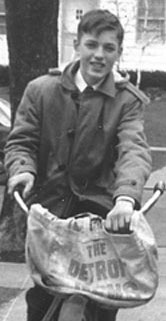
“You had to do it so they don’t come unrolled when you fling ‘em,” says Graham, whose maiden name is Hanchon. “There was an art to that.”
She has several other stories, too.
How she and Don would try to sneak out of the house to play, only to be caught by their mother and told to keep an eye on Sally, their younger sister.
Or how the two would ride bikes or play four-square with the same-aged siblings down the street, Ron and Julie White.
Or how on a Saturday morning, when there were chores to be done, Don would always find the ideal hiding space.
In fact, speaking with members of the Hanchon family, the stories are always well-told, and there seems to be an unending cache of amusing anecdotes. Lauri and her brother both credit their dad for the storytelling gift.
Such was a pleasant element to what Bishop Hanchon remembers as a “the ideal childhood.”
The family — with seven siblings, Bishop Hanchon being the fourth — grew up in Wayne. The church, St. Mary Parish, was down the street. The neighborhood had several large, Catholic families, making for lots of friends and good times. And the Hanchon parents, John and Alfreda Hanchon, were active volunteers in the community who knew their neighbors well and were frequently up for socializing.
“We just had great, great times,” said Bishop Hanchon, who said in his childhood he was closest to his sister Lauri. “I didn’t know it wasn’t everyone else’s experience until I got older.”
Loving parents
Bishop Hanchon recorded the touching thoughts down in a booklet assembled in 1999 to mark his 25th year of the priesthood:
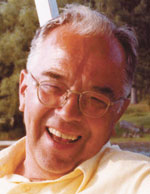
“I am not unique in realizing how profoundly Dad and Mom’s love has shaped my life,” he wrote. “But I am increasingly aware, as an adult, of how special each of them has been. Hardly a day passes that I do not ‘remember’ them and give thanks for the vocation their faith provoked in me … for the unique person I am because of the people, attitudes and values they taught me to cherish.”
During his childhood, Bishop Hanchon describes his parents as those who fostered his love of people, willingness to get involved and affection for the Church — those same attributes that have marked his priesthood.
“My dad was an usher. Mom was in the altar society, and with the hospital auxiliary” he says. “They were always volunteering for things, always involved in that way.”
On summer days, the family would pack into the ’47 Plymouth and head out to visit some family friends on a farm. In near-unbearable fashion for a group of kids, John Hanchon would pass a few ice cream shops along the way, but refused to stop because the shops were on the opposite side of the road. The kids eventually learned that he did it on purpose.
Some nights, John would tell the kids stories before bedtime — making them up as he went.
Then there were the occasions where Alfreda and John would invite their friends over to the house and host square-dancing parties in the basement.
Good times like these marked Bishop Hanchon’s childhood. And the affection among family members lasted a lifetime. John Hanchon passed away in 1990. Alfreda Hanchon passed away in 2001.
When it came to Bishop Hanchon’s vocation, he says his parents couldn’t have been better about being supportive, but not pushy.
“My parents were just about perfect,” he says. “They said it would be wonderful (if I were a priest), but they also let me know if I found out it wasn’t for me, that’d be OK, too.”
Sibling support
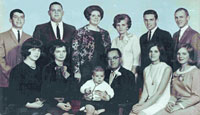
In their youths, the family was able to experience prayer together, Bishop Hanchon recalls.
“We had family rosary in May and October,” he says. “There were religious images in the home. We always had images of the Immaculate Heart of Mary and the Sacred Heart of Jesus in the living room. And a crucifix.”
After a joyful childhood together, Bishop Hanchon’s siblings weren’t surprised when their brother opted to enter the seminary high school.
“He was a good boy,” Graham says. “He was a good Catholic school student, he loved to sing.”
His older brother, Thomas, says there always has been something admirable about Don, even when he was young.
“Although I’m four years older, it seems as though I’ve looked up to Don my whole life,” Thomas Hanchon said when it was announced that his brother would be a bishop. “He was a great little kid.”
In fact, some of Bishop Hanchon’s favorite memories involved both the Church and his brother Tom.
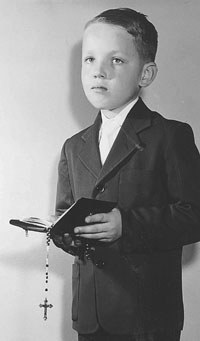
“I loved to serve (Mass),” recalls Bishop Hanchon. “Tom and I used to serve the early Mass for many years. We were a team with another set of brothers.”
One of his first trials in being involved with Church life, Bishop Hanchon remembers, was having to learn the Suscipiat, the Latin prayer over the gifts in the Tridentine Mass.
“You couldn’t be an altar boy until you were in the fourth grade and you could recite all the prayers in Latin,” Bishop Hanchon recalls. “That was the one everybody stumbled on. I went through that trial.”
Still close
The Hanchon siblings — Lauri, Thomas, Martha, Francis and Sarah — still are close. Paula (Carrico) passed away in 2006.
Lauri says her son, Peter, upon graduating high school, traveled to Mexico with then-Fr. Hanchon. On his return, he said “traveling to Mexico with Fr. Don was like traveling with Jesus.”
It’s clear that, as Bishop Hanchon embarks on his episcopal ministry, he’ll have a loving family at his side, even as he grows closer to his Church family.
“For a long time, you don’t take your sibling very seriously, and I don’t think it was until we saw him in action that we did,” says Graham. “He’s a wonderful preacher, and when you’re in his church visiting, the people are extremely reverent, and it kind of spills over onto you.
Graham adds that he’s an ideal choice as a bishop, because he’s down to earth and embraces not Church politics, but rather the true calling to spread God’s Word and love to those who he sees are in most need of it.
“He’s as real a person as you’re going to meet,” Graham says. “What you see is what you get. He really is that humble and that devoted, and he just has lived a very, very good life.”