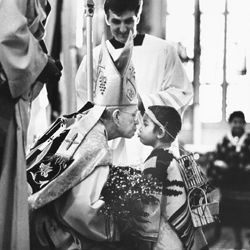
Having grown up in modest surroundings as the son of Polish Immigrant and his wife, Casimir and Mary Szoka, the Grand Rapids native worked his way through high school and the seminary to be ordained by Marquette Bishop Thomas Noa in 1954. Within three years, he was sent to study in Rome. And within seven years, he became Bishop Noa’s secretary.
When named a bishop, Fr. Szoka also had been a pastor, assistant chancellor, chancellor, and an attendee of Vatican II.
He was ordained July 20, 1971 and installed as the first bishop of the new Diocese of Gaylord, created by Pope Paul VI from 21 northern Michigan counties that had been part of the Saginaw or Grand Rapids dioceses.
|
There, he received a responsibility that few bishops get – to start a diocese from scratch. When he began, there was no cathedral, chancery or diocesan offices. He spent a decade organizing the diocesan structure and raising funds for the necessary staff to run the new diocese.
Summoned to Rome in March 1981 to meet Pope John Paul II, he learned he would succeed Cardinal John Dearden as archbishop of Detroit. He was installed as archbishop on May 17 of that year.
On taking the helm of the Detroit Archdiocese, he faced financial difficulties to which he was able to apply his past experience, and also faced challenges of enforcing Church discipline in two controversial cases.
During his tenure here, he showed himself willing to put principle above popularity.
In 1987 Archbishop Szoka welcomed Pope John Paul II to Detroit, as the Holy Father made his historic visit that included events in Hamtramck, at the Cathedral of the Most Blessed Sacrament, and at the Pontiac Silverdome.
The following year, he was elevated to the College of Cardinals and oversaw the virtual re-inventing of Sacred Heart Seminary through the addition of a graduate school of theology, or “theologate,” plus a revamping of its undergraduate program and the addition of lay ministry programs.
Cardinal Szoka left Detroit in 1990 to take up a new ministry to the worldwide Church when the pope called him to the Vatican to serve as president of the Prefecture for the Economic Affairs of the Holy See. He has helped lead the Vatican back to financial health.
He would go on to serve as president of the Pontifical Commission for Vatican City State – informally as “governor” of Vatican City State.
In 2002, Cardinal Szoka submitted his resignation to the Holy Father, as all bishops must do on their 75th birthday, but was asked to continue working. Continuing to serve, he overcame multiple and significant health problems in 2003. His resignation to his Vatican post was accepted in 2006. He since has moved back to the Archdiocese of Detroit, where he lives in Northville and celebrates Mass at local parishes.