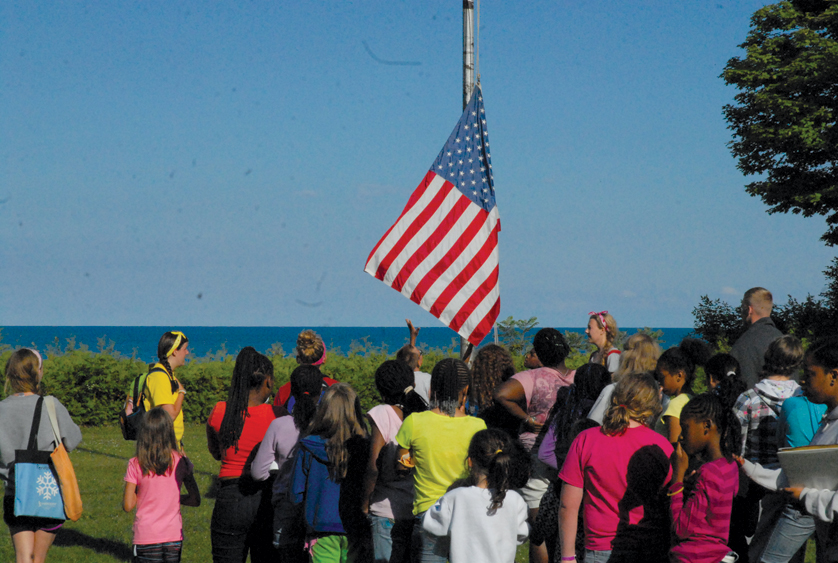
 After dinner, but before evening activities commence, campers lower the flag.
Loving Arms Camp provides fun, extra support to kids who’ve suffered a loss
Carsonville — Sitting at the long wooden table in the camp dining hall, the kids watched as two women in bright yellow shirts explained the difference between feeling emotions on the inside, and showing them on the outside.
“What are some feelings you have on the inside but don’t show on the outside?” asked Theresa Williams, a staff member with St. John Health System’s Open Arms, a grief support program.
Responses from the 8- to 12-year-old children included “anger,” “pain” and “sadness” — perspectives from kids who had all suffered the loss of a friend or family member.
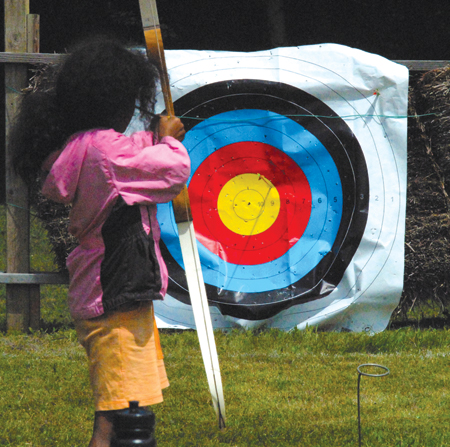 A young camper lines up her perfect shot while participating in archery at Camp Ozanam.
“Sometimes you’re sad and people don’t know you’re sad,” continued Williams. “You guys are going to learn the difference between the two.”
Williams and her fellow program leader, Phyllis Kearney, helped the children paint and decorate plastic craft masks to demonstrate how hiding one’s emotions, like using a mask, prevents people from seeing what is happening underneath.
These kids were participating in the Loving Arms Camp, a unique camp experience offered through a collaboration between St. John Health System and Camp Ozanam, a Society of St. Vincent de Paul (SVdP) summer camp for boys and girls.
This year, the camp was held July 7-12, coinciding with Camp Ozanam’s traditional six-day, co-ed camp. Loving Arms campers participated in an hourlong session from Tuesday to Friday, and then returned to the rest of their camp community to continue regular camp activities.
And while the only true difference in schedule between Loving Arms and the traditional camp was the grief-processing activity, Williams and Kearney said they could see how Loving Arms helped the children.
“This year we have about 15 kids,” said Kearney, explaining that the Loving Arms campers’ backgrounds can involve “any cause from homicide to natural causes.”
Because their St. John Health System program is called “Open Arms,” Williams said they had decided to title the camp program “Loving Arms” to keep the same theme.
Kearney explained that some children “don’t open up that first time, but then they hear others’ stories.”
“Toward the end, they realize that ‘what we’re feeling is normal,’” she said.
She said that just as with the rest of the SVdP camps, the cost is free to attend Loving Arms. She added that “we do have kids that opt out, and we can do one-on-one (counseling) with them.”
Williams and Kearney said they have had a number of returning campers who appreciated the program so much that they ask to attend the following year.
“One camper didn’t sign up for Loving Arms, but he begged his mother to allow him to come for the remaining days,” said Williams, adding that the number of campers varies during the week, as some children request to join Loving Arms, and others decide they are not ready for the program.
 Campers at the Society of St. Vincent de Paul’s Camp Ozanam play football July 9 with a camp counselor.
“Often we assume that children won’t bring up grief,” she said. “We deal with the hurt and pain.”
Once the Loving Arms campers had completed their session, they joined the other kids in various camp activities including archery, crafts, sports and swimming in Lake Huron right beside the campground.
Julia Hohner, Camp Ozanam’s camp counselor team leader, said children are given the chance to attend camp who might not otherwise have had the opportunity.
“It gives the chance to be away from home; some do have great home lives, but it gives an experience that they might not have had if it was not provided for free,” said Hohner, who is majoring in psychology at John Carroll University in Cleveland.
Hohner said the campers “love to learn about Jesus and ask their parents to take them to church … I think it plants seeds that they might not get elsewhere.”
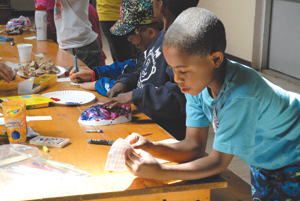 Loving Arms campers make masks while learning about showing one’s emotions on the outside.
Camp counselor Reynaldo Salce Jr., a seminarian studying at Sacred Heart Major Seminary, said it was his second year serving at Camp Ozanam.
“A lot of the kids don’t get to be kids at home; a lot come from broken homes not necessarily from poverty but through being underprivileged,” said Salce, who was inspired to help at Camp Ozanam by fellow seminarians who had served in the past.
He said that he prays the Divine Office with his cabin and will read the Bible with the kids. He added that while the campers did not always see the importance of the prayers, eventually “they’d get excited” to participate — even offering some “questions about the priesthood.”