DETROIT —
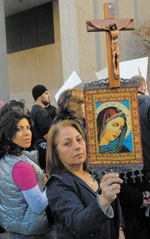
Local Iraqi Christians turned out in force Nov. 8 to protest violence against Christians in their homeland, and to call for U.S. action to end it.
The Oct. 31 massacre that left 58 dead and 75 wounded in the Syrian Catholic cathedral in Baghdad was just the latest of nearly 66 attacks on Christian churches by various radical Muslim factions in recent years, said the signs carried by some of those who filled the sidewalk in front of the Patrick V. McNamara Federal Building.
One participant estimated there was a turnout of at least 1,600 people, and perhaps as many as 2.000, including Chaldean Catholics and members of the Ancient Assyrian Church of the East.
“The Iraqi government offers no protection whatsoever,” said Sabah Kama, a member of St. Joseph (Chaldean) Parish in Troy.
Kama said the attackers in the Oct. 31 incident called the Christians heathen and did not even spare children in their carnage.
Joe Kirma, also a St. Joseph (Chaldean) parishioner, echoed the sentiment expressed by many that United States forces in Iraq should have been insisting that the Iraqi authorities protect the Christian minority or, failing that, provide that protection themselves.
“Either protect them or bring them here,” Kirma said.
Francis Marogi, a member of Mother of God (Chaldean) Parish in Southfield, said Iraq’s Christians should not have to be “sacrificial lambs,” to be slain by “savage people.”
“Everybody has their own militias, except the Christians. The government promises to protect them, but they’re not,” Marogi said.
Sam Katto, another Mother of God (Chaldean) parishioner, said there is also an element of ethnic cleansing to the attacks on Christian churches.
“We are the indigenous people of Iraq, with a history that goes back 7,000 years, Katto said, referring to the fact that most of the country’s Christians are ethnic Assyrians (Chaldeans are Assyrian Christians in union with Rome).
The country’s Muslim majority, on the other hand, is made up primarily of Arabs, with ethnic Kurds predominant in the north.
But the lack of concern for Iraqi Christians is hard to understand, Katto continued.
“If one Muslim is killed anywhere, angry Muslims will rise up around the world, but 66 Christian churches have been attacked, and nobody says or does anything,” he added.
Bishop Ibrahim N. Ibrahim, bishop for Chaldean Catholics living in the eastern United States, placed responsibility for inaction squarely on the U.S. government.
He said the United States has the upper hand in Iraq and such influence on the country’s government that it could insist on anything it wanted.
“If the security situation is not good enough, then why did the United States pull back from combat operations?” he asked.
The bishop gave the Iraqi government low marks in other areas as well.
“The situation in Iraq is worse and worse and worse and worse — not only for the Christians, but in a special way for the Christians,” Bishop Ibrahim said.
He estimated that so many Christians had left the country in recent years that Iraq’s Christian population might be down to half of what it was in 2003, or 500,000.
“It’s certainly no more than 600,000” the bishop said.
Bishop Ibrahim said he had tried talking with the State Department and elected officials about the plight of Iraqi Christians.
“If you talk with politicians, they agree with you. They say, ‘You’re absolutely right,’ but nothing happens,” he said.
That same week, the president of the U.S. Conference of Catholic Bishops urged the U.S. government to “redouble its efforts to assist Iraqis” in providing safety for its citizens, especially religious minorities.
“To meet its moral obligations to the Iraqi people, it is critically important that the United States take additional steps now to help Iraq protect its citizens, especially Christians and others who are victims of organized attacks,” said Cardinal Francis E. George of Chicago in a Nov. 9 letter to U.S. President Barack Obama.
Reminding Obama that the U.S. bishops had expressed “grave moral questions” before the U.S.-led combat began in Iraq and had warned of the “unpredictable consequences” of that action, Cardinal George said, “The decimation of the Christian community in Iraq and the continuing violence that threatens all Iraqis are among those tragic consequences.”
He said the Oct. 31 attack on the Syrian Catholic cathedral, along with recent bombings in Baghdad, “are grim evidence of the savage violence and lack of security that has plagued the Iraqi people, especially Christians and other minorities, for over seven years.”
Although the U.S. bishops welcome the end of U.S. combat in Iraq, Cardinal George said, the United States “has so far failed in helping Iraqis to develop the political will needed to deploy effective strategies to protect the lives of all citizens.”
“Having invaded Iraq, our nation has a moral obligation not to abandon those Iraqis who cannot defend themselves,” he added.
The cardinal outlined a series of steps that, “at a minimum,” the United States and the international community must help Iraq to achieve:
- “Enable the Iraqi government to function for the common good of all Iraqis.
- “Build the capacity of Iraq’s military and police to provide security for all citizens, including minorities.
- “Improve the judicial system and rule of law.
- “Promote reconciliation and the protection of human rights, especially religious freedom.
- “Rebuild Iraq’s shattered economy so that Iraqis can support their families.
- “Assist refugees and internally displaced Iraqis.”
— Catholic News Service contributed to this story/U.S. Conference of Catholic Bishops