

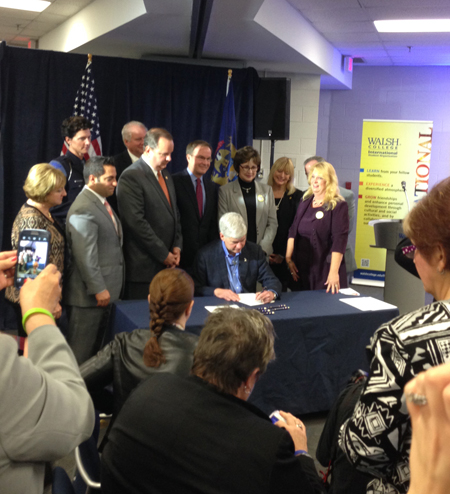
 ichigan Gov. Rick Snyder signs a 22-bill package creating new protections and services for victims of human trafficking Oct. 16 at Walsh College in Troy.
Michigan Catholic Conference championed efforts to create ‘safe harbor’ for victims
Lansing — Gov. Rick Snyder signed into law a package of bills Oct. 16 that could help Michigan fight human trafficking on a variety of fronts, a culmination of nearly two years of work that drew strong praise from Catholic leaders.
During a ceremony at Walsh College in Troy, the governor signed 22 bills that will create new protections and services for victims of human trafficking.
Among the bills signed into law are measures that would create a “safe harbor” for minors who engage in prostitution or similar crimes under the assumption that they were coerced by another person; and a measure that could allow victims of human trafficking to have their criminal records expunged for certain crimes committed while being trafficked.
“Human trafficking is an affront to the dignity of the human person, and vulnerable women, men and children deserve greater protection from its harm, said Rebecca Mastee, public policy advocate for the Michigan Catholic Conference, in a statement. “The bills signed today address this very real problem from many angles, starting with identifying survivors, ensuring they are not treated as criminals, and connecting them quickly with necessary resources and services.”
According to the U.S. Department of State, nearly 300,000 American teenagers are trafficked yearly for sex, and an additional 17,500 people are trafficked into the U.S. from other countries annually. Last year, the FBI conducted a sweep in which 105 children forced into prostitution were rescued across the country, including 10 in Metro Detroit and Flint.
The new laws also include a provision that would allow victims to receive medical benefits, psychological treatment, counseling and adoption services through the Department of Human Services, and a requirement to register as a sex offender for anyone soliciting or engaging a prostitute who is under 18. A formal human trafficking commission will also be created at the state level to ensure public awareness, analysis and training for professionals who work with survivors.
Mastee said the new measures were a testament to the work of both Republicans and Democrats, as well as advocates within the Church and elsewhere.
“This was a collaborative effort all the way through the legislative process, and for that, credit is due to members on both sides of the aisle, in both chambers and across the executive branch of state government,” she said.
Sarah Nash, coordinator of the Justice, Peace and Sustainability Office of the Monroe-based Sisters, Servants of the Immaculate Heart of Mary, said the laws’ passage followed the release of a Polaris Project report showing Michigan as a “Tier 2” state based on its human trafficking laws. Although Tier 2 is the second-highest rating in the report, most other states were rated as “Tier 1” by the advocacy group, which works to fight human trafficking nationwide.
Nash called the new laws a “step in the right direction” and said she hoped their passage would push Michigan into Tier 1 as well, especially with the creation of the formal commission, which is one of the criteria.
Pope Francis has also said his message for the Jan. 1, 2015, World Day of Peace will focus on human trafficking as a “crime against humanity” and a threat to world peace.