Warren — At 80, Prel Gjokaj (pronounced joe-kai) is able to enjoy the flourishing state of those things he has helped nurture and grow over the years — his family, St. Paul (Albanian) Parish, and the fig and quince trees in his backyard.
It is all a long way from the prospects he faced as a 9-year-old orphan back in his native Montenegro as World War II was about to convulse Europe.
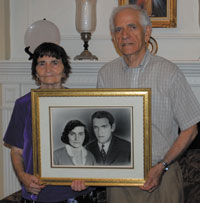
Gjokaj and his wife, File (pronounced fee-leh), will celebrate 56 years of marriage later this year, along with their children and grandchildren, who all live in metro Detroit.
When Prel Gjokaj brought his family to Detroit in 1972, the small Albanian Catholic community of that time was renting space from a church in Detroit’s old Poletown area for one hour a week. They later moved to Our Lady of the Rosary Church on Woodward.
But Gjokaj was among the members of that community who envisioned Albanian Catholics someday having a church of their own, and who worked to acquire the land and build the first St. Paul (Albanian) Church on 12 Mile Road in Warren, which opened in 1981.
Gjokaj, who served as a parish council member and later as its president, said he and others believed “we needed more than just a church, we needed a life center” to help local Albanians advance and hold the community together.
So, the 12 Mile Road property included room for classes, meetings and wedding receptions, as well as fields for soccer games.
“When they dug the foundation for that building, I finally began to see my hopes coming to fruition, and could say our community had put down real roots here,” he said.
Now, like many local Albanians, especially those on the east side of the metro area, one of the proudest achievements of his life has been helping to make St. Paul Parish what it is today, with its handsome stone buildings on Auburn Road near Rochester Road in Rochester Hills, which are visible from M-59.
The new St. Paul complex, which opened in 2002, includes room for all the activities the old property accommodated, plus even more.
As with the earlier structure, building the new parish center required great sacrifice from many in the Albanian Catholic community, not only in terms of financial support, but also in in-kind donations of labor and services.
“The people wanted it, the people demanded it, and the people built it,” Gjokaj said.
Besides St. Paul Parish, with 1,400 registered families, the west-siders who split from the original group to form Our Lady of Albanians Parish now also have a fine church and parish complex in Southfield for their 600 families.
But there is also a sad aspect to the growth in the local Albanian community, as it was largely fueled by people fleeing human rights abuses in the old country.
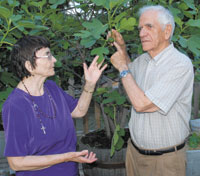
Looking back on his youth and early life in Montenegro, then a part of Yugoslavia, he tells how his parents died when he was 9, leaving two brothers, a sister and himself orphans.
Relatives raised the siblings as if they were their own, but older brother Zef was eventually drafted into the Yugoslav army and his sister, Lula, married a man across the border in Albania.
At that time, the border was easily crossed by the Albanians of Albania and those of the neighboring Montenegro area of Yugoslavia. Later, as the leaders of Albania and Yugoslavia took their countries in vastly different directions, the border would become impermeable.
“That was the hardest thing for me — not seeing my sister for 35 years,” Gjokaj said, explaining that it was not until 1984 that he was able to obtain permission from the Albanian government to make a visit.
Although his sister died in 1991, the same year Albania’s hard-line communist regime collapsed, three of her daughters now live in metro Detroit.
By the time Prel was 17, big brother Zef was back from his military service, and Prel was conscripted to do national service for Tito’s Yugoslavia, working on repairs to roads and railroads in Bosnia.
That was followed by being drafted into the Yugoslav air force, where he was a driver.
But when he got out, his relatives banded together to see to it that he got an education, and he studied textile design in Sanguk, Serbia.
He married File in 1955, and began to raise a family. Then, in 1961, he was chosen to go on a trade mission to Poland and Czechoslovakia, and to undergo training in the use of modern textile machinery in Lodz, Poland.
Gjokaj said both countries were far more advance in industrial technology that Yugoslavia, but he especially noticed how much freer the Church was in Poland than in his own country.
In Yugoslavia, the government didn’t care if elderly people went to church regularly, and a younger person could get away with going occasionally, say at Christmas and Easter, without a problem. But for a younger person to go regularly or become involved with a parish, it would mean loss of any government job and denial of educational opportunities for his children, he said.
Gjokaj returned to Yugoslavia to a position at a textile producer in Titograd (nor Podgorica). Ironically, the plant mostly produced material for U.S. military uniforms.
A further trade mission to Italy showed him how much better things were in the West, and a 1970 trip to visit his younger brother, Vata, in Detroit, convinced him he wanted to emigrate to the United States.
Vata Gjocaj had come just two years before, and was already running a small restaurant in addition to working a good job at Dodge Main. He sponsored their older brother, Zef, to come over and helped him get started in this country.
Italy had been impressive, but Prel Gjokaj said the United States “was like going to another planet” compared to his home country.
“Once I got to see the free world, I figured I had to look out for my kids’ future and follow my brothers to the United States, even though for the Yugoslavia of that time, we had it pretty good,” he recalled.
Despite having what was considered a good job and better than average living quarters – and achieving all that without having to join the Communist Party.—he nevertheless yearned for the greater freedom and opportunity for his family that they could find in America.
Selling his wife on the idea was the hardest part about getting out of Yugoslavia, because it was always possible to pay under the table for the government’s permission to leave, as when he proposed to take his family on a vacation to Italy. But Italy was just a year-and-a-half stopover for the Gjokajs while they awaited permission to come to the U.S.
Once here, they lived with Vata in the same building as his restaurant.
Prel Gjokaj had made the move just in time. Once here, his health collapsed, as kidney problems and sinus infections made it impossible for him to do steady work.
But File was able to get a job at a bakery and oldest son, Mark P. Gjokaj, not yet 15. was able to work with his uncle at the restaurant and later land a job at the St. Regis Hotel.
Mark Gjokaj and his brother bought their own restaurant, at Greenfield and Fenkell, and later sold it. Mark now, at 53, owns MPG Construction, MPG Epoxy Floors and Better Painting Co.
While Prel helped some with his son’s endeavors, his activities have mostly centered around the Albanian community – working to build up St. Paul Parish, advancing the cause of Albanian human rights and serving as a community mediator.
He became a U.S. citizen in 1981.
Prel and File Gjokaj live with Mark and his wife, Tonka. Their other children, Toma and Maria, also live in the area. Altogether, they now have 14 grandchildren.
Prel Gjokaj noted that the Catholic Albanians of the Greater Highlands areas of Albania and Montenegro never gave up their faith during 500 years of rule by the Turks, some 80 years of domination by the Serbs and nearly a half-century of communism. But it has been here in America that they have truly been able to live and practice their faith freely.
“For me, it’s almost like a rebirth since I came to this country,” he said.
Prel Gjokaj said today’s St. Paul Parish is the result of a lot of hard work and sacrifice on the part of many parishioners, as well as the leadership of Fr. Anton Kcira, who is retiring this year as parish administrator.
As his wife put it, “I have it much better here than over there. We have our church, and our priest, and are able to get together with our people. The church makes me happier than any other thing.”