(OSV News) ─ When Bishop Fredrik Hansen of Oslo, Norway, first encountered Sigrid Undset's writing in junior high school, it was through her famous novel trilogy "Kristin Lavransdatter." It did not catch his attention at the time, as he was not yet Catholic and not particularly interested in medieval Norwegian history.
However, in returning to the trilogy as a Catholic priest years later, Bishop Hansen saw an "interplay of humanity and faith there that is quite significant."
He reflected on the unique witness in Undset's writing and her life in an interview with OSV News following his July 8 announcement that preparations were underway in Norway to open a canonization cause for the Nobel Prize-winning novelist.
"She's very much a Christian and a Catholic in the modern world," Bishop Hansen said. "Her life was complex. She lived in turbulent times, and part of her life was turbulent. But at the same time, there is, certainly from the time of her conversion to Catholicism, a couple of strands that I think point towards the heroic living of the virtues, which is the first step of any cause of canonization."
A public Catholic in a Lutheran land
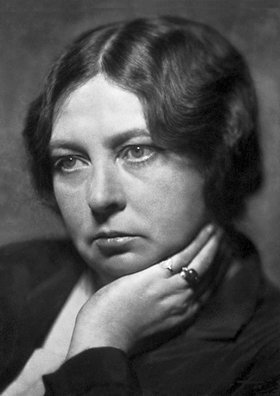
Born in Denmark in 1882 and raised in Oslo, Undset was nominally Lutheran but not religious in the early years of her life. She established herself as a promising young writer in Norway and entered a marriage that resulted from an affair with a married man, the artist Anders Svarstad. They had three children, including a daughter who had disabilities. She and Svarstad separated in 1919 and their marriage was annulled when she became Catholic in 1924.
She won the Nobel Prize in Literature in 1928 "principally for her powerful descriptions of Northern life during the Middle Ages" especially in "Kristin Lavransdatter," published in 1920-1922.
"She was a public figure in Norway, well-known in the country, when she converted to Catholicism, at a time when there were almost no Catholics in Norway, and where a strand of anti-Catholicism was still quite prominent," Bishop Hansen pointed out.
"So, when she became a Catholic, she met public opposition, public ridicule and became, in a way, 'the Catholic' in the country, and therefore was challenged repeatedly to explain ─ to in some way stand firm in defense of ─ her belonging to the Catholic Church and to the Catholic faith," he said.
He praised Undset's "valiant defense of Catholicism" which displayed her "dedication to truth and to justice."
"We, of course, as Norwegians, remember her also for the work that she did during the Second World War to promote the Norwegian cause of liberty," he added. "She stood up against Nazism."
Undset's books were burned by the Nazis due to her outspoken critique of Nazism, eugenics and the persecution of Jews. Her oldest son, Anders, was killed fighting the Nazis and she was forced to flee to Sweden and eventually the United States when the Nazis occupied Norway in 1940.
During her time living in New York City, she publicly advocated for Norwegian resistance to Nazism. She returned to Norway after the end of the war in 1945 and died in 1949 in Lillehammer.
Championing a Christian view of humanity
Bishop Hansen told OSV News that in Undset's dedication to the poor, to her daughter with disabilities, to Norway and against totalitarianism, she "becomes a voice for a Catholic ─ a Christian ─ understanding of humanity, of Christian anthropology that was very clearly under pressure from various sources because these thoughts that came to their extreme in Nazism were also present in European society: eugenics, this kind of aggression against human life."
"She stood up for" that Christian understanding of humanity and "in the face of so much opposition, remained firm in what she believed in and had given her life to," he emphasized.
He also noted the "significant evangelizing reality in her writings," praising "her ability to present these great spiritual themes, connecting them to realistic lives."
He sees a great deal of appreciation for her writing in Norway and around the world. Shortly after he was appointed a coadjutor bishop of Oslo in 2024, he received several independent requests encouraging him to investigate a cause for Undset's canonization, he said.
There were "prayer groups or circles of people that in one way or another showed interest in Sigrid Undset, but an interest that was not literary, that was more raising her up as an example of Christian life," he explained.
Widespread devotion
Bishop Hansen said that one source of encouragement to open a cause came from the United States.
"There was a Catholic who had been in contact with the Dominican sisters in the convent here in Oslo, where Sigrid Undset stayed for significant periods of time, that wanted to share a spiritual gift that this Catholic felt came through the intercession or the witness or the example of Sigrid Undset," he said.
Bishop Hansen spent over five years working in the U.S. ─ first in New York at the Permanent Observer Mission of the Holy See to the United Nations and then teaching at St. Mary's Seminary and University in Baltimore ─ and he was "very surprised at the attention given to Sigrid Undset in Catholic circles, starting with young Catholic women, where I kept hearing of book clubs … that came together and read 'Kristin Lavransdatter.'"
He also heard of priests using Undset's writings for evangelization, he said.
Bishop Hansen plans to have prayer cards in English sent to the U.S. because he is "hopeful that this cause will be aided by prayer and spiritual support" of Americans.
He noted that in addition to interest from the U.S., he has heard from other corners of the world where Undset has served as an inspiration, including from a priest in Australia who wrote his doctoral dissertation on her.
"For a cause of canonization to have international cult is a real solid sign that there's something here that is of value to the universal Church, not only to the Diocese of Oslo," he said.
Finding strength in the Church
Bishop Hansen said he kept hearing feedback from those reading her works that they portray "people that are dealing with much the same as people have always dealt with and then in this kind of setting where faith is not an add-on, not something that is just one part segmented out of it, but is very much part of everything."
"Several of the works of historical fiction from medieval Norway, this comes out also throughout: That they go to church, the church bell rings, there's a procession, all of this context to it, but then also in the individual characters, there is the life of faith," he said.
"This perhaps is also one of the great aspects of Sigrid Undset that she lived a lot of that herself," he continued. "And obviously her life had its ups and downs, perhaps more downs than ups, but a woman who struggled in her life, but then found in the Church and in the Catholic religion that which then sustained her and I think strengthened her."
He also noted the example of a continual turning to God that Undset offers.
Not only did she discover the Catholic faith, he said, but she underwent changes in her life and "on some level, I think constant change, which is the life of all of us, of conversion, of repentance, of turning to God and in that growing, also in our lives as Christians, that we should, in a sense, learn from every confession we make."
Continual conversion
Bishop Hansen said people can learn from Undset "in our day by day, in our year by year, striving to improve as Christians, to also be able to recognize and to deal with our flaws, to be able to face them, to really take responsibility for them."
"She was blunt with herself. I think she was honest and rather than hiding away, she dealt with what was there," he said.
For those who would like to start reading Undset, Bishop Hansen recommended her work "Saga of Saints" about the Norwegian medieval saints, which became his "renewed contact" with the writer, he said.
Bishop Hansen appreciated "her contribution to our understanding as Catholics in Norway today of our medieval past," which illustrated the "very long and deep roots of Catholicism as a way of bringing the Church together."
'Nothing is guaranteed'
He recognized that opening Undset's cause means "years and years of intensive and complicated work" because "she has left us so much written material."
"Obviously, every cause of canonization is a study. Nothing is guaranteed," he said. "It's not something to be taken lightly, but still something that our diocese now should undertake."
There are administrative steps that need to be taken to formally open her cause, and Bishop Hansen is hoping that the first of those steps will be taken this fall.
He made the announcement of the plans to open her cause for canonization at a Mass celebrating the feast of St. Sunniva in the ruins of the Benedictine monastery on Selja, an island that is considered the birthplace of Norwegian Christianity and home to its first diocese.
His announcement came 100 years after Undset visited the holy place of Selja in 1926 on pilgrimage. According to legend, the 10th-century Christian queen St. Sunniva fled Ireland to escape marriage to a tyrant and ultimately died on Selja, after which miracles were attributed to the site.
Holiness, not perfection
Bishop Hansen has heard from some who think Undset would be against the opening of her own cause for canonization.
In one letter to a friend about her conversion, she quipped, "I had fancied I would be una sancta perfecta, as soon as I was received into the Church and had received Holy Communion and then I experienced 77 irritating incidents and became grumpy and angry as a Catholic woman should not be, and behaved not like a saint at all."
"It's very easy to create an image of the saints or of holiness or heroic virtues as being absolute perfection in life," Bishop Hansen said.
"Holding up an example of someone perhaps as complicated as Sigrid Undset, but one who at the same time, as far as I can see, displays something that is also beyond, that is more than simply average and that truly has something to show us by way of example," he said, "will offer a realistic example of our striving for holiness: that means it is possible to struggle, to have one's ups and downs, but still be so dedicated to the Lord that one's life is truly changed."
- - -
Lauretta Brown is culture editor for OSV News. Follow her on X @LaurettaBrown6.