


Alan Piñon | The Michigan Catholic
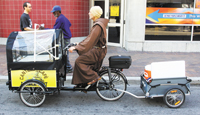 Detroit — It’s a little after 8 in the morning on Saturday as Bro. Al Mascia, OFM, rides a three-wheeled street vendor’s bike through the streets of Detroit. Wearing a brown habit and a pair of sandals, the sight of Bro. Mascia to most people might seem unusual. But to someone like Daniel, who makes $600 a year, the sight of Bro. Mascia on his tricycle is not only familiar, it is literally a God send, for inside the bike is free food.
“If this wasn’t available to me, I might not have much else to eat some days,” Daniel says.
On this Saturday, two of these street vendor bikes, which look like the hot dog carts you might see on the streets in New York, bring hot coffee, muffins, and homemade cookies. On better days, when the ministry gets help preparing food from suburban churches, the carts offer breakfast sandwiches, too.
This is Bro. Mascia’s bicycle ministry, a mobile soup kitchen of sorts that was born out of necessity.
For years, Bro. Mascia, who is a Franciscan Friar, and other volunteers and staff ran a warming center and soup kitchen for the needy at St. Aloysius’ Outreach Center.
Unfortunately, the building that houses St. Al’s Center has deteriorated to the point where the cost of repairs exceeds what either the parish at St. Al’s or the Archdiocese of Detroit can afford, meaning the soup kitchen and warming center had to close down.
But Bro. Mascia didn’t see the closure as the end. He simply thought that if those in need can’t come to him, he will go to them. He thought back to his days living in New York and eating from the street vendors and went to work to procure a vendor bike. And with that, his bicycle ministry was born.
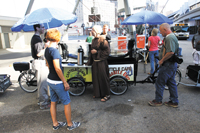
Now, Bro. Mascia and a small group of volunteers hit the streets 5 days a week in two or three carts to deliver food and beverages to the needy.
“This allows us to really connect with the people we serve,” Bro. Mascia said. “We are out here in the elements with them; there are no counter tops between us. We are side-by-side with them on the streets. We get to know them and their story, which helps us, often, to better find ways to help them,” he said.
And connect with them he does. Bro. Mascia can tell you some background on most of the people that visit the carts. He often knows where they sleep, what addictions they might be struggling with, or in Daniel’s case, how he got his shoes.
“Daniel said he prayed for six months, everyday for a pair of decent shoes,” Bro. Mascia says. “And one day, while digging through the trash, he came across a real solid pair of leather shoes.”
Daniel confirms the story and adds that the shoes were exactly his size, and that he contributes the find directly to prayer. “It was a gift from God, I have no doubt,” Daniel says.
“The more we know about their struggles the more we know what kind of help they need. We have reached into the hearts of these people by reaching them where they live,” Bro. Mascia said.
Getting the carts on the streets is only the first step to reaching those he serves. After the carts are parked, usually at the Rosa Parks Transit Center, Bro. Mascia goes walking around the neighborhood to let people know.
Many, like Jennifer Mandeville, have come to really rely on the bicycle ministry.
“I have been down and out a long time. A little bit of food and a beverage like this helps people make it through the day. This is an amazing thing they do. So many people depend on this. If this disappeared, I don’t know what people would do,” Mandeville said.
Being on the streets has also taught Bro. Mascia to be more observant. Unfortunately, the lesson was one learned the hard way. On January 24, Brother Al found a woman almost frozen to death on the streets. He sat with her while help was called, but even with medical assistance she succumbed to the weather and died.
“It was a wake-up call of sorts for us. We realized we need to be vigilant and aware, especially in extreme weather, for those who are in need of assistance but can’t ask,” he said.
Now, Bro. Mascia keeps a mental inventory of his regulars. If one doesn’t come around for a while, they start calling other shelters to see if he has been seen. Bro. Mascia and his volunteers also try to assess the physical health of those they see. If there is a serious problem, they call for help.
Most of the people that visit the carts need some sort of medical assistance, and that has led Brother Al to his next goal. He wants to get another cart that can be outfitted with medical supplies and serve as a mobile triage unit. He has $1,500 for the $2,000 needed to get the cart. The money, he thinks, will come, but he is currently looking for volunteer nurses that can hit the streets with them to provide the necessary medical services.
Bro. Mascia wants to grow this bicycle ministry into an army of riders. He sees the real impact this has on those in need, and the need, as it is now, far outweighs the help they can offer.
“I would like to really infiltrate the city with these services,” Bro. Mascia said. “The city needs this. We want to be part of the renewal of Detroit, but in a way that doesn’t brush the homeless and needy aside.”



