Music ministry can be a life-long vocation for some people, and many parish musicians blessed with long life and good health continue to serve long after most people would have retired.
The Archdiocese of Detroit has benefitted from the commitment of a number of pastoral musicians who have served well into their senior years, among them Budweil, Mary Nellenbach and Mary Farley.
Walter Budweil
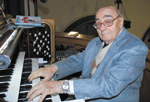
Budweil, who also still uses the Polish form of his first name — Wladyslaw — turns 90 years old today, but says he has no plans to retire.
“No, not yet. I have a good pastor (Fr. Bogdan Milosz), I have good people to work with me, and I am still able to do the work,” he says.
Budweil began playing the organ and conducting a choir for Masses in 1935 in his native Poland, and has been music director at Our Lady Queen of Apostles Parish in Hamtramck since Sept. 1, 1950.
Young Wladyslaw learned the piano at home as a boy growing up in Sanok in southern Poland. When the family moved to Krakow in 1935, his music teacher selected him to serve as organist for school Masses and to lead the choir at the all-boys high school he attended.
He and the choir also provided the music for the 9 a.m. Sunday Mass at the Carmelites’ Visitation of the Virgin Mary Church in Krakow.
Since his teacher was also director of the Krakow Conservatory and only came by the school two days a week, the teen-aged Wladyslaw was already, from age 14, doing the work of planning, rehearsing and performing that he would later do as his career in the United States.
He graduated from high school in 1939, but World War II began with the German invasion of Poland later that year.
In September 1940, Budweil was summoned to the Gestapo office in Krakow, as were two of the monks and the principal singer with the choir. All four were arrested; Budweil was sent to the infamous Auschwitz concentration camp.
As bad as it was to have to do 12 hours of forced labor every day, Budweil recalls it was even worse seeing so many fellow prisoners die. While the Nazis did not subject the Polish prisoners to the wholesale extermination they inflected upon Jewish prisoners, they had a way of working them to death.
“Mostly, when someone came to Auschwitz, they died within about three months, whether from starvation, bad food or overwork,” he says.
And even if the Nazis had no work for the Polish prisoners to do, they would make them carry bricks back and forth for the 12 hours, Budweil remembers.
In 1943 he was among the prisoners transferred to Buchenwald, another notorious concentration camp.
Buchenwald was near Weimar, and Budweil remembers there being an oak tree with a nearby plaque telling that the poet Johan Wolfgang von Goethe (1749-1832) used to come there for inspiration. “They (the Nazis) had more respect for that tree than for human beings,” he remarks.
Budweil was transferred yet again in 1944, this to Schoenebeck, where he was put to work making parts for fighter planes for the Luftwaffe.
He recalls how, when the camp was liberated by American troops, the first GIs to show up were Polish-Americans. “We were surprised when the Americans, who had noticed the triangles with the letter P on our uniforms, greeted us with ‘Jak sie masz?’ Budweil says.
In a displaced persons camp after the war, he met and married his wife, Jadwiga, who had been a prisoner in a Nazi slave labor camp. And they’re still married after all these years.
A friend sponsored them to come to the United States in 1950, and the position at Our Lady Queen of Apostles opened up shortly after he arrived.
When he started the job, the parish was still worshipping in the basement of its school building. But the new church, with its Cassavant Freres organ, was completed in 1952.
That organ has been a special joy for Budweil. “What Cadillac is to cars, Cassavant is to organs,” he says.
Along the way, he and Jadwiga raised three children in their home just a few blocks from the church.
Asked what was the highlight of his more than 60 years with the parish, Budweil answers readily, “The visit of Pope John Paul II in 1987.”
Budweil assembled, rehearsed and conducted the 194-voice choir that sang for the late pontiff’s Hamtramck stop, an event that drew about 50,000 people.
“That was something to remember,” he says.
Budweil says he has been blessed with good choirs at the parish over the years, which he also counts among the joys of his job. He has also directed the Filarets Chorus, a prize-winning Polish-American singing group, and he helped compile a Polish hymnal that is used in many Polish American parishes.
Noting that his birthday falls on the feast of the Annunciation, he speaks of his devotion to Mary and points to the carved wood-sculpture of the Madonna and Child that sits atop his organ console.
“I think I’m blessed with health, because the Blessed Virgin wants to keep me around as long as she can – she’s taking care of me,” Budweil says.
Mary Nellenbach
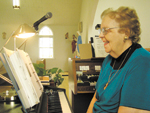
Nellenbzch, 80, pastoral musician at St. Mary Parish in Burnside Township, has been playing the organ in Catholic churches since 1960.
Over the years, she has also served at SS. Peter & Paul Parish, North Branch; St. Patrick Mission, Clifford; and Sacred Heart Mission, Brown City.
And Nellenbach has filled in as an occasional substitute at Immaculate Conception Church, Lapeer, and at Sacred Heart Church, Imlay City.
“I also get called to play at funerals and weddings. It’s kept me busy,” she says.
Also keeping her busy during this past half-century has been raising nine children, she points out.
Growing up in the Flint area, she studied piano with private teachers there. Then, in 1948, she married Paul and they moved to North Branch.
“When I got married and moved here, I had to do a bit of coercing to get a piano brought into the home. The kids would be outside playing, and they would say they could tell my temperament by the kind of music I was playing,” she recalls.
Nellenbach says her greatest joy over the years has been the increase in congregational singing: “The people are singing up a storm now – they’ve really become a 500-voice choir.”
Compared to what she used to do, Nellenbach considers herself semi-retired now, but she says she has no plans to fully retire as long as she can still do the job.
“As long as my fingers move, I think I can keep it up. When it gets so they don’t do what I want them to, I guess I’ll have to hang up my hat.
Mary Farley
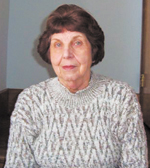
Farley, 79, started playing the organ at St. John Parish, Allenton, in 1944 when she was 13.
“I played there off and on until 1954, when I got married and we moved to Imlay City,” she says.
Since then, besides raising two children, she has played and conducted the choir at Sacred Heart Parish, Imlay City, though now she considers herself semi-retired.
But even though she stepped down as the parish’s principal organist in 2001, Farley says she has enjoyed mentoring the young organists who have come after her, as well as still playing for funerals or other times when her services are needed.
At Imlay City she has had a fine Wickes pipe organ to play, but she still recalls those early years in Allenton when she played an organ that she had to pump herself.
“It was an old antique organ that you worked the foot pedals, and mice kept getting in it. To play louder you had to pedal harder and you pushed apart these boards with your knees,” she says.
Farley says the greatest joy has been “when people really sing, when they lift their voices and really sing out.”
“We didn’t have that when I was a child. The music just flowed over them – they weren’t really a part of it,” she says.