And in Knoxville, St. Joseph’s sixth-grade Klueless Klowns team took the top honors with their “Coming Attractions” presentation from among the 1,276 teams from 45 states, seven Canadian provinces and 13 other countries who had made it through state and regional competitions for a shot at international ranking.
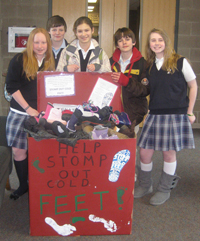
And one of the other four teams from St. Joseph School, the Boot Brigade, came in eighth in the global finals, with their “Stomp Out Cold Feet” social service project.
“This is just unbelievable! I am so extremely proud of them, and what they’ve achieved for themselves and for our school,” said St. Joseph’s principal, Sylvania Franciscan Sr. Teresa Darga.
Besides winning the finals’ central challenge, the Klueless Klowns also won the Destination Imagination Renaissance Award, just as they had earlier done at the state competition.
The appraisers (judges) at the global finals, in their explanation for their decision to give the Renaissance Award — a special honor only occasionally granted — said the live silent-movie trailer produced by the team “knocked the appraisers’ socks off.”
Citing the technical ingenuity and smooth operation of the team’s presentation, the comments continued, “The professionalism this team brought to all aspects of their performance overwhelmingly raised their work to an award-winning level.”
For the St. Joseph students, the finals at the University of Tennessee marked the culmination of a remarkably successful year in the academic competition, which seeks to foster creativity and problem-solving skills in young people.
“I am so proud of our students. It’s an experience I think is just invaluable to children,” Sr. Darga said of the competition, with which the school has been involved for nearly a decade.
Five teams from St. Joseph
At the state tournament April 21 at Central Michigan University in Mount Pleasant, five teams from the school earned the opportunity to compete at the global finals — an unprecedented accomplishment for any Michigan school.
|
Destination Imagination affords students the chance to compete in three categories — Scientific Challenge, Fine Arts Challenge and Community Service Challenge.
A St. Joseph fourth-grade team, nicknamed the Solar Swimmers, captured first place at the regional competition in March and first place in the state competition April 21 in the Solar Stage scientific category, which challenged teams to create a theatrical performance about solar energy, build a prototype that demonstrates a new way to collect, capture and use solar energy, as well as design theatrical lighting to illuminate the completely dark presentation site.
The fifth-grade team, The Mechanical 5, won second place in the technical challenge with “Assembly Required.” The team was asked to design and build equipment that retrieves parts and delivers products; assemble products from team-provided parts to fill orders; use the products in a presentation; and present a team-created story about something that happens “just in time.”
Two teams competed in “Coming Attractions,” the fine arts challenge that had teams present a live movie trailer involving characters from at least two nations, design a working cinematic special effect, and create an original soundtrack that complemented the trailer.
The sixth-grade Klueless Klowns team won third place and, while only the top two teams move on to the global finals, was granted a “wild card” invitation because it was the closest third-place team among all the challengers. The team also was awarded a rare Renaissance Award, which recognizes teams who demonstrate extraordinary amounts of effort, preparation and outstanding skill in engineering design and performance.
A seventh/eighth-grade team called Super Sassy Silly Sixth Sense took first place in the fine arts challenge with a movie trailer about four individuals and their theories regarding the end of the world.
In the Project Outreach challenge, a seventh/eighth grade team called The Boot Brigade captured first place for assessing, designing and completing a drive to collect winter boots for those in need. With a “Stomp Out Cold Feet” campaign, the students collected and distributed 175 pairs of boots to the Department of Human Services in Tuscola, Genesee, Lapeer and Oakland counties.
Students learn skills
For K.C. Eisbrenner, a 12-year-old girl in sixth grade in her seventh year of Destination Imagination, it was her team’s second trip to the global finals.
K.C. said she likes that her team “gets to solve problems in ways that no one else could think of.”
“I learn how to work together with people who are very different from me. It’s cool, because they think differently than I do, so they come up with things that I would never think of. Then, we can put all of our ideas together and make something special.”
Eddie Spengler, 10, a fifth-grader and member of The Mechanical 5, said it was fun because “you get to show off your talent.”
“It helps you get better at performing, too,” he said. “My favorite part about DI is that you get to compete. It makes you always wonder if you will advance or not.”
Gretchen Altenberger, 13, a seventh-grader and member of the Super Silly Sassy Sixth Sense team, has been participating in Destination Imagination since she was in kindergarten.
“At the start of every year my team spends hours reading over the different challenges and imagining what we might do with them. I love these brainstorming meetings. We always have lots of creative and crazy ideas. It’s tons of fun putting together what we each do best and coming up with something original,” she said.
“It's like we are on a journey together. We learn lots of new stuff every year,” she said, including how to use power tools to build structures from PVC and wood, how to sew costumes and puppets, and how to paint and create 3D props, along with lots else.
Ricky Johnson, 14, an eighth-grader and member of the Boot Brigade, said he liked matching up against the other competitors.
“From where we start on day one of beginning the challenge up until the performance day, it’s incredible how much you can do, and how much you can learn from one another and yourself. It is also inspiring to have so many people from our school cheering you on. It shows we are a close family. Everyone is rooting for one another, even if we are competing against them,” he said.
But participation does require a significant time commitment, Ricky continued. He said on average, he spends about eight hours a week working on the challenge over a six-month period.
For Ricky, the satisfaction came not only from winning, but from what he and his team members accomplished. “I achieved the knowledge that I made a difference in my community. I was able to make future winters just a little bit easier for someone in my community,” he said.