POPE FRANCIS, “Evangelii Gaudium”
This is the fourth in a six-part series in The Michigan Catholic highlighting the impact of Pope Francis on various aspects of Catholic life and ministry. For others in the series, visit the links below.
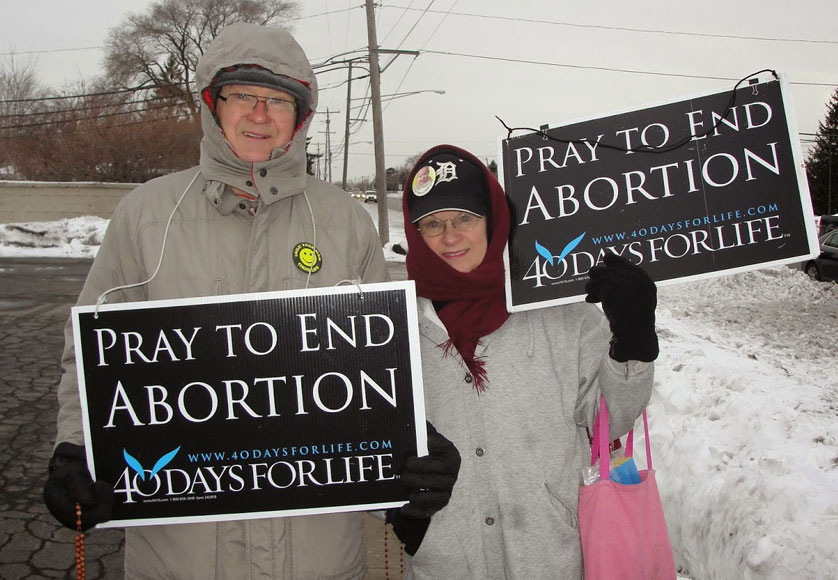 Richard Kucharek and Jenny Pozniak pray and witness outside an abortion clinic in Sterling Heights on March 13 as part of the 40 Days for Life vigil. In addition to protecting the unborn, the pope has also called on Catholics to show mercy and compassion for post-abortive mothers.
Detroit — When it comes to aiding the vulnerable in society, “I think we need to examine our own relationships with one another,” says Sr. Ann Oestreich, IHM.
|
Sr. Oestreich, a member of the Justice, Peace and Sustainability advisory committee for the Sisters, Servants of the Immaculate Heart of Mary in Monroe, helps create awareness about one of society’s hidden but crucial problems: human trafficking.
“I think trafficking flourishes because people are being seen and treated as commodities rather than as human beings,” said Sr. Oestreich.
Sr. Oestreich has spent many years working to curb the issue. She said these particularly defenseless members of society are hurt through the culture’s apathy toward others.
Uniting with other U.S. women’s religious orders, such as the Sisters of Holy Cross in Indiana, the IHMs serve “in solidarity with one another and respond especially as it affects women and girls throughout the world,” said Sr. Oestreich.
Citing Pope Francis’ frequent appeals to end to human trafficking, Sr. Oestreich said his starting point in this concern, as well as all social concerns, “is the dignity of the human person.”
It’s a theme the pope has referenced often during his yearlong papacy, often in connection with the Church’s response toward the vulnerable, which can include victims of human trafficking, abortion and even at-risk youth.
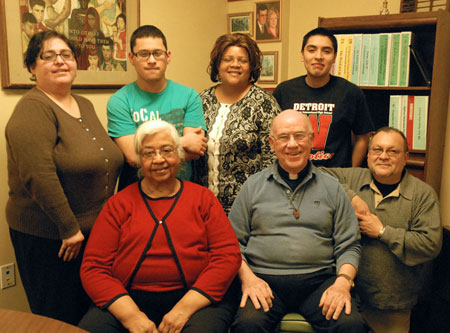 Life Directions, a program aimed at guiding and encouraging at-risk youth in the Detroit community, has served the area since 1973. Back row is Sandra Ortiz, Ricardo Aquino, Annette Howard and Emmanuel Miranda. Front row is Sr. Rosalie Esquerra, OP; Fr. John Phelps, CSSR, and Juan Sandoval.
Establishing dignity
Nancy Seubert, coordinator of the IHM Justice, Peace and Sustainability office, has worked with the sisters for 15 years in addressing the issues affecting human dignity, especially human trafficking.
Seubert said human trafficking falls into two categories: sex trafficking, which counts for 70 percent, and labor trafficking, which is the other 30 percent.
“It is so hidden,” said Seubert, “particularly sex trafficking, which is a private, secret interaction.”
Seubert said there are countless misconceptions about human trafficking, which help keep so much of it shrouded in secrecy.
“An obvious misconception is, ‘It doesn’t happen,’” she said, adding that another is the belief “that people who are victimized are doing it because they want to.”
Seubert said even within the Catholic Church, it is easy to walk away from addressing this situation as too ugly and complicated make a difference.
“It is a reality that Catholics, Christians and other people of faith need to be aware of,” she said, encouraging community education about the issue. “The truth is, you can make a change.”
Mentoring youth
In 1973, Fr. John Phelps, CSSR, realized that the widespread violence in Detroit was resulting in the frequent deaths of numerous youths. He noticed Detroit teenagers were especially struggling because they lacked proper guidance or direction in their lives.
“We wanted to make it possible for the vulnerable to connect,” Fr. Phelps said in an interview with The Michigan Catholic.
After uniting with four other concerned citizens, including Sr. Rosalie Esquerra, OP, an organization called “Life Directions” was formed.
Fr. Phelps said the core of Life Directions is to “treat people with dignity where they’re at.”
He referenced Pope Francis’ apostolic exhortation “Evangelii Gaudium” (Joy of the Gospel) in that Life Directions, through peer and adult mentorship, evangelizes by walking with people.
With both adult and youth leaders reaching out to at-risk teens both inside and outside school hours, youths are encouraged to follow wherever their “life directions” point.
Life Directions is also based on the natural family unit, explained Sr. Esquerra: “We do go through hard times, but there’s someone who can help me with this struggle.”
Ricardo Aquino, a junior at Western International High School in Detroit, is a co-chair of Life Directions’ youth board. Beginning his freshman year, Aquino attended a Life Directions peer motivation program held by Sr. Esquerra.
“Life Directions is how I learned not only about high school, but also life,” said Aquino, who credits Life Directions with boosting his confidence.
Emmanuel Miranda, a youth board co-chair and fellow junior at Western, said as a freshman he was “pretty much a loner.”
But through attending the same peer program, “I’ve interacted with people I wouldn’t have (before).”
Juan Sandoval and Sandra Ortiz, both parishioners of Ste. Anne de Detroit Parish, serve in Life Directions’ “Focus Family” and “Focus Life” programs, respectively. These programs work to engage the families in the local community by offering mentorship and guidance opportunities.
“I put myself out there for them,” said Ortiz, explaining that she grows through helping the families. Sandoval agrees.
He said he meets with the families “to help them along and get more involved in the community.”
Annette Howard, Life Directions project director, has a special place in her heart for the program. In 1974, she attended a Life Directions retreat as a troubled young adult.
“I was able to label what I was feeling as ‘very lost,’” she said, explaining that Life Directions shared with her the “presence of God, and a love for humanity.”
Second chances
Pope Francis’ message of mercy and concern for the vulnerable includes victims of abortion — the result of what the pope has called a “throw-away culture” and a “horrifying” reality that views children as “disposable objects.” But the pope has made clear that mercy also extends to post-abortive mothers, who often feel deep regret and sorrow for their choice.
“Everyone seeks peace,” said Fr. Denis Theroux, pastor of Our Lady of Victory Parish, Northville, one of several priests in the Archdiocese of Detroit who counsels post-abortive individuals.
“For me, it is the recognition that all of our hearts need to be healed because all of our hearts are filled with sadness and despair over things we have done in our lives,” said Fr. Theroux, who works with the post-abortive healing ministry Project Rachel.
“I believe there isn’t anything God can’t touch or heal,” he said.
Many post-abortive men, while also dealing with the guilt and shame, frequently struggle with anger, question their masculinity and fear close relationships, he said.
And while many couples have been known to separate after an abortion, Fr. Theroux said that of those who remain together, there is a “silent scar that remains in that relationship for years because they don’t know how to approach the topic.”
“Project Rachel exists to bring to the surface the emotions all over this loss, not only to talk about it, but to bring it before God and ask God to come and touch it and heal it,” he said.
Fr. Theroux said the Church is there for anyone who is hurting and must never judge them, regardless of past decisions.
“I have had people in the Church respond negatively to me because I am involved in post-abortive healing,” he said. “But when Jesus met the woman caught in adultery, he didn’t push her aside, but said her sins are forgiven, ‘go in peace.’”
Maggie Walsh, the main coordinator of Project Rachel in the Diocese of Grand Rapids, through Catholic Charities West Michigan, has worked with many people both inside and outside her diocese.
“Sometimes people struggling with post-abortion healing issues prefer to go outside their own geographical area,” she said.
Walsh said Project Rachel is a great tool in the New Evangelization, “and of course, Pope Francis has been focusing on reaching out to the marginalized, which is what Project Rachel does.”
Though the term “life-changing” can be overused and over-applied, she said, “Project Rachel truly is changing lives of those who were involved with abortion decisions.”
Help the vulnerable in your own community
• For ways to curb human trafficking in your community, visit http://usccb.org/issues-and-action/human-life-and-dignity/human-trafficking/index.cfm.
• To report tips, connect with anti-trafficking services or request resources, call the National Human Trafficking Hotline at 1-888-373-7888. Further information can be accessed from the National Human Trafficking Resource Center at www.polarisproject.org.
• For more information about Life Directions, visit www.lifedirections.org or call (888) 552-0540.
• Confidential assistance for those seeking healing from abortion is available through Project Rachel at 1-888-RACHEL5 (1-888-722-4355) or [email protected]. For more information about post-abortive healing, visit www.hopeafterabortion.com.