POPE FRANCIS, “Evangelii Gaudium”
This is the fifth in a six-part series in The Michigan Catholic highlighting the impact of Pope Francis on various aspects of Catholic life and ministry. For others in the series, visit the links below.
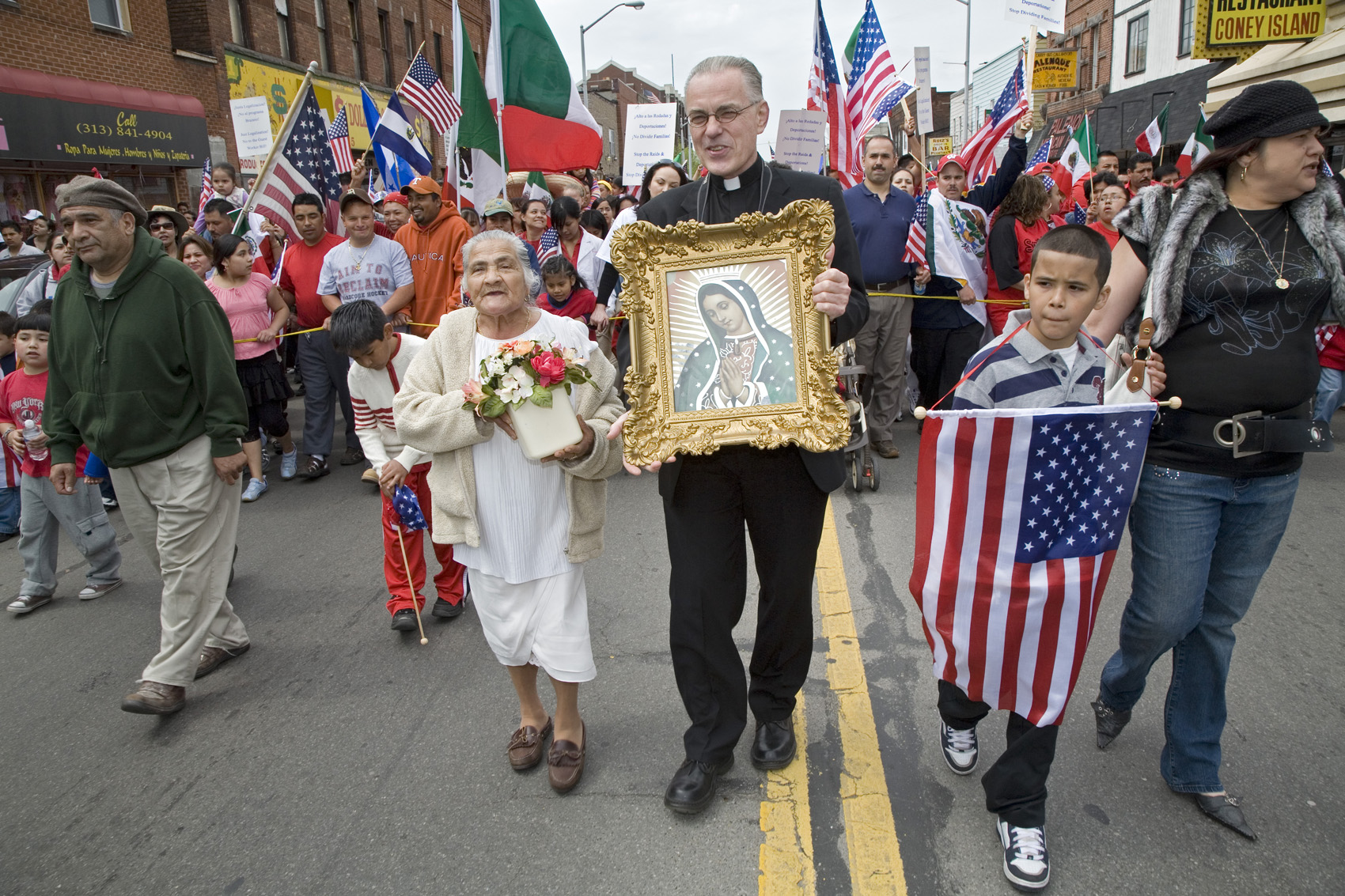 Auxiliary Bishop Donald F. Hanchon, then-pastor of Most Holy Redeemer Church in Detroit, holds an image of Our Lady of Guadalupe as he marches with protesters during a 2007 immigration rally in downtown Detroit. Photo by Jim West.
Bishops Hanchon, Cepeda stress local Church’s welcoming arms
Detroit — “When people have no place to go, shouldn’t they be able to come to the Church?” asked Auxiliary Bishop Donald F. Hanchon.
|
Bishop Hanchon, who has served the Metro Detroit Hispanic community for many years, calls the United States’ immigration dilemma a “political football that just gets tossed back and forth.”
And too often, Bishop Hanchon explained, the politics of immigration reform overlook the actual people involved.
“I think the Church has a moral obligation to speak up for them, because nobody else will,” he said in an interview with The Michigan Catholic.
The bishop said he admires what Pope Francis has had to say about the need to reach out to and help migrants and refugees in one’s own country.
“He’s saying ‘I know it’s inconvenient’ … (but) there are lives at stake, and people’s futures,” Bishop Hanchon said. It can be as simple as welcoming a new face at church, he said: “Let them know that the Church is home for them; it should be a safe place to be.”
For the sake of freedom
Deacon David Herr of Our Lady of Redemption Melkite Catholic Church in Warren left South Lebanon on Feb. 1, 1965.
“People don’t want to leave their land,” Deacon Herr said. “They cannot take the land away and put the dirt in a different country.”
Deacon Herr pointed to the ongoing exodus of Christians from the Middle East because of the heightening oppression and violence: “It hurts me to hear these things.”
“People are leaving their country to be able to practice Christianity like they should, and to save their lives and their families,” he said. “The position is not easy for anybody.”
For the Christians coming from the Middle East, the price of safety is costly as they attempt to build new lives in the unfamiliar land of the United States, Deacon Herr said.
While attempting to find employment is one significant difficulty, even everyday habits and patterns of living are drastically different, he added.
“In your own country you could grow things to eat, nine to 10 months out of the year,” he explained, pointing out the major climate difference between southeast Michigan and the much warmer temperatures in the Middle East.
Deacon Herr said prayers for the Holy Land — where Pope Francis will visit in May — need to be stronger, but he also encouraged his Western brothers and sisters to be open to helping Eastern Christians in this country — both financially and spiritually — especially during Lent.
“Pope John Paul II said the Church breathes with two lungs; the East and the West,” he said. “If I don’t love my brother who I see, I won’t love my God who I don’t see.”
The pope’s experience
Auxiliary Bishop Arturo Cepeda, a native of Mexico, said he admires Pope Francis’ ability to reach out to those of various backgrounds, within a context of great hope and great joy, which Bishop Cepeda believes “is one of the best witnessing tools.”
This is seen especially in his strong support for immigration reform, he added.
Because Pope Francis’ own parents were migrants, Bishop Cepeda said, “It’s already a part of his own story, just as in my own case, coming from Mexico with my family; I’m also an immigrant.”
“You definitely speak with your experiences as a person, as a Catholic, as a Christian, and now in his case as pope,” Bishop Cepeda said. “Coming to the issue of immigration reform, that’s what he brings in a very unique, human, humble way … this is important for us as a Church.”
He said he was glad one of the topics the pope mentioned in his March 27 conversation with President Barack Obama included immigration issues, noting that the issue is in the “very heart of (Pope Francis’) pastoral outreach.”
Bishop Cepeda stressed that the Catholic Church upholds the dignity of the human person “from the womb to the tomb, as we say.”
“Many of our immigrants who are undocumented in the United States live in the shadows,” he said, adding that a better policy will help in reaching out to these individuals.
“They are a blessing to our community and society,” the bishop said. “Our laws at this point are breaking our families. We want an immigration reform that brings families together, that brings the undocumented out of the shadows to be able to be a blessing to our country.”
“All these groups are part of who we are as a human race,” he said.
How to help
One of the ways to help immigrants and migrants in our community is through Catholic Charities of Southeast Michigan, whose resources include Hispanic Outreach Services and Immigration & Refugee Services. Contact them at (855) 882-2736 or email [email protected] for assistance, or to find out how you can help.