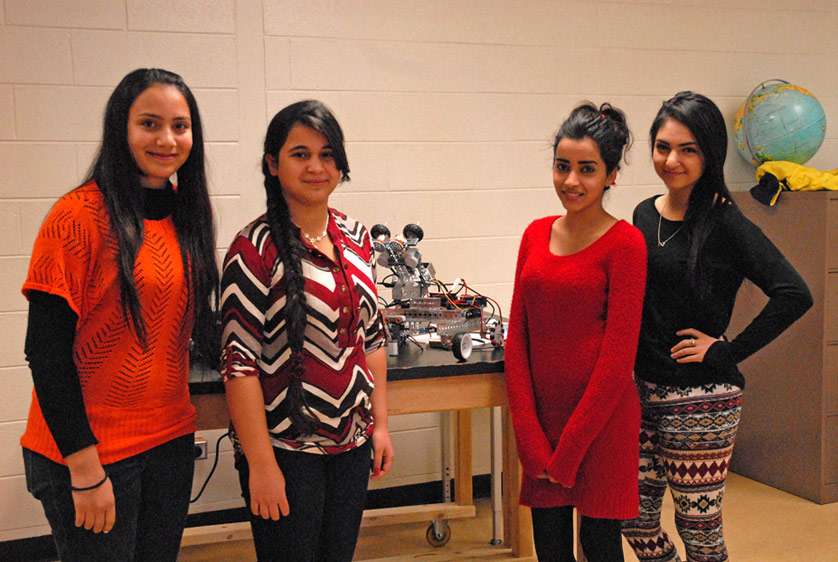
 Left to right, Maryam Kafra, Israa Alfadhli, Farah Sabah and Regina Alsabagh attend Wilkinson Middle School in Madison Heights. Two of the girls are Chaldean Catholic, one is Muslim and one is Baptist, but all have become close friends over their shared science project and background as refugees, despite their religious differences.
Victims of religious persecution, girls grow close over Space Station project
Madison Heights — Though the four young Iraqi refugees come from different religious backgrounds, “we’re sisters,” explained Farah Sabah.
Farah, 14, attends eighth grade at Madison Heights’ Wilkerson Middle School with 13-year-old Maryam Kafra, 13-year-old Israa Alfadhli, and 14-year-old Regina Alsabagh.
Maryam and Regina are Chaldean Catholic, Israa is Muslim and Farah is Baptist, but all four came to the United States within the past two years to escape religious persecution in their homeland.
The students are still learning English, and so portions of their conversation with The Michigan Catholic were translated by Wilkinson’s lead enrichment teacher, Angel Abdulahad.
The four girls had made headlines when they submitted a science project to a program carrying 18 students’ experiments to the International Space Station. Though the rocket carrying the students’ experiments malfunctioned and exploded Oct. 21, they and their fellow amateur scientists recently received news they will be able to re-submit their projects at no cost.
The girls were overjoyed to learn that their hard work — which started in February as students competed to get their projects accepted by the program — would receive a second chance.
Abdulahad said their excitement was particularly poignant considering the reasons behind their project, which involves purifying E. coli-infected water with iodine tablets while in zero gravity.
Abdulahad said the water-purifying project was not arbitrarily chosen: “They actually took a human concern. Most third-world countries struggle with that, and they themselves struggled with that (in) Iraq.”
Randy Speck, superintendent for the Madison District Public Schools, said that through the water project “we want there to be hope; we want children in Iraq to see hope.”
The girls didn’t know each other well when they started as students at Wilkinson, but through their joint project efforts and shared persecution experiences, they have grown quite close.
Abdulahad said when the girls began their project in February, “Farrah had just arrived … Israa knew Maryam a little bit because they were in my ESL class.” Regina had been there since fall 2013.
However, in working and learning English together, friendships began to grow.
As a Muslim, Israa had experienced similar persecution as that of her Christian friends, Abdulahad said, explaining her father had been threatened in Iraq for not requiring her to wear a head covering.
“They come here together and they have the same background of this persecution and getting picked on, and businesses being blown up, watching deaths all around them,” Abdulahad said.
Speck said today the girls walk everywhere together and are inseparable.
Regina said the girls had arrived as strangers, but “knowing someone understands your language, you’re going to automatically be attracted to that person. And you’re going to learn from one another.”
Their religious differences are inconsequential, she said: “It’s the heart that counts.”
The girls said Maryam is the least talkative of the group, but still feels as deeply as they do because she “writes it all in her heart.”
Speck said the example of these eighth-graders from different backgrounds would be good for adults to notice.
“I’ve never heard them argue like adults do about differences and religion,” Abdulahad said. “The unique part is that they love each other for who they are … that has never been a barrier for them.”
The girls look forward to the re-submission of their water experiment, and were recently inspired by a letter sent from a 13-year-old boy from Santa Monica, Calif., who had heard about their project in the news.
The boy expressed his sadness at what had happened to the rocket, but explained that this is just another obstacle: “You can overcome it,” he wrote.
“You can never be too confident and anything can go wrong at any point or time … this was meant to happen for a reason and sometime in the future it will all pay off,” he wrote.
Israa said the boy’s letter was very encouraging.
“It’s beautiful because there are other kids our age that (now) know what’s possible,” she said.
The girls offered advice to those who also experience obstacles: “Do something your future self will be thankful for,” said Regina. “And believe in yourself; never say never.”