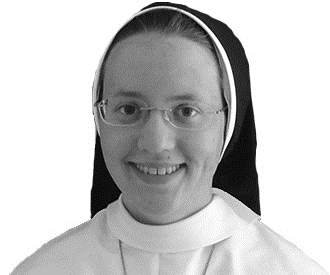

 Sr. Maria Veritas Marks is a member of the Ann Arbor-based Dominican Sisters of Mary, Mother of the Eucharist.
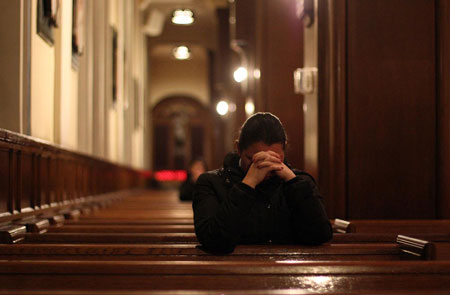
Gregory A. Shemitz | CNS Photo
Despite the beauty of the English language, its Germanic roots sometimes obscure linguistic connections crystal clear in Romance languages like Spanish and Italian. One striking example is the word “thanks,” whose Spanish and Italian versions — gracias and grazie respectively — retain the link to the Latin gratus, which means both “dear” and “grateful” and which, in turn, comes from the Greek charis, “grace.” “To give thanks,” in Greek, is literally, “to eu-charist.” Think about that at your Thanksgiving meal!
The Church has called the Eucharist the “source and summit” of our lives (Lumen Gentium §11), and this means that thanksgiving is at the heart of all that we do. It is a thanksgiving modeled on Christ’s, who, hours before undergoing the most terrible physical and spiritual suffering any man has ever or will ever know, “took bread and, when he had given thanks [“eucharisted,” in the Greek of the New Testament], broke it, and gave it to His disciples” (Mt 26:26).
The Eucharistic preface of the Mass reminds us every Sunday that “it is truly right and just, always and everywhere to give you thanks, Lord, holy Father.” Always and everywhere? A priest visiting our Motherhouse this summer drew the Sisters’ attention to the challenge inherent in this statement. We are proclaiming that it is right and just to give God thanks in the hospital room where a young mother is dying of cancer. It is right and just to give God thanks in the NICU as a baby just born breathes his last in the arms of his mother. In the jail cell. In the funeral home. Always and everywhere.
Why always and everywhere? Perhaps because of a truth St. Josemaria Escriva, a Spanish priest of the last century, loved to quote: Omnia in bonum: all things work together for the good of those who love God (Rom 8:28). If we love God enough to continue believing in His goodness even in the midst of tragedy, that tragedy — “all things” — will be transformed into something beautiful for His glory and for our own and others’ eternal happiness.
We should give thanks for everything in our lives, for every joy and for every sorrow, because each is an occasion of grace. Giving thanks is simply an acknowledgment of reality, the reality that everything good we have is a gift and that everything evil will be turned, through God’s power and with our cooperation, into a greater good. In union with our Savior, we can join all happiness and all suffering to His offering to the Father on Holy Thursday and Good Friday, in order to be raised to new life with Him in a series of little Easters each day.
Happy Thanksgiving!
Sr. Maria Veritas Marks is a member of the Ann Arbor-based Dominican Sisters of Mary, Mother of the Eucharist.