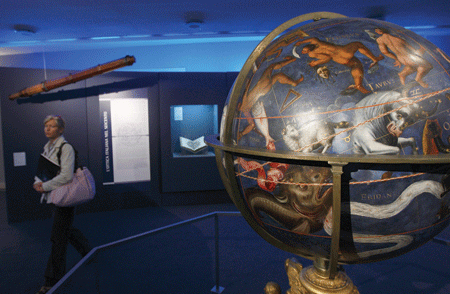
 A globe of the heavens from 1567, showing the main constellations seen from Europe, is displayed in a 2009 exhibit at the Vatican Museums. Despite professing to believe in "science" and "logic," the atheist places as much faith in matter - and perhaps even more - than the Christian does in God.
Paul Haring|CNS Photo
To the Christian, God created ex nihilo (“from nothing”). To the atheist, everything can be explained through the laws of nature.
Yet, these natural “laws” somehow attained their remarkable organizing abilities; one either explains them through materialism (the theory that everything is “explained” by purely material processes) or by humbly bowing to divine teleology at some point.
Matter essentially “becomes god” in the atheist/materialist worldview; it has the inherent ability to do everything by itself. Christians, on the other hand, believe God created matter and natural laws with the potential and characteristics they have, as their ultimate Creator and ongoing Preserver and Sustainer.
The atheist places extraordinary faith in matter — arguably far more faith than we place in God, because it is much more difficult to explain everything that “god-matter” does using science alone.
Indeed, this is a faith of a non-rational, almost childlike kind. It is quite ironic, then, to hear the constant charge that we Christians have a blind, “fairy tale,” gullible faith, as opposed to the self-described “rational, intellectual and sophisticated” atheist.
In reality, atheistic belief is [see my explanatory “disclaimer” at the end] a kind of polytheistic idolatry of the crudest, most primitive sort. The ancient Babylonians, Philistines, Aztecs, and other groups believed that their silver amulets and wooden idols could make the sun shine, defeat an enemy or cause crops to flourish. The polytheistic materialist, on the other hand, believes trillions of “atom-gods” and their distant relatives, the “cell-gods,” make everything in the universe occur by their own power, possessed eternally either in full or (who knows how?) in inevitably unfolding potentiality.
One might call this (to coin a phrase) Atomism (“belief that the atom is god”). To the atomist, trillions of omnipotent, omniscient atoms can do absolutely everything that the Christian God can do, and for little or no reason that anyone can understand (i.e., why and how the atom-god came to possess such powers in the first place). The atomist openly and unreservedly worships these trillions of gods, with the most perfect, trusting, non-rational faith. He or she is what sociologists call a “true believer.”
In a similar way, the atomist’s goddess, time, is also invoked in reverential, awe-inspiring terms as the be-all, end-all explanation for things inexplicable. It’s as if by magic that her very incantation rises to an explanatory level sufficient to silence any silly Christian who is foolish enough to believe in one God rather than trillions. The “time-goddess” is the highest in the ranks of the atomist’s varied hierarchy of gods (sort of the “Zeus” of Atomism). We may title this belief Temporalism.
Atomism is a strong, fortress-like faith. It is often said that it “must be” what it is. In this way, the atomist reverses the error of the Gnostic heretics. The Gnostics believed spirit was great and matter was evil; atomists believe matter is great (and god) and spirit is not only “evil” (metaphorically speaking), but non-existent.
Atomists may and often do differ on secondary issues, just as the various ancient polytheists differed on quibbling details (which god could do what, which material made for a better idol, etc.). Despite this, they all inevitably came out on the side of polytheistic idolatry, with crude material gods, and against spiritual monotheism.
Yet in Atomism, each person is a god, too, because he or she is made up of trillions of atom-gods and cell-gods.
Within the atomist faith-paradigm, this makes perfect sense. But for one outside their circle of religious faith, it might not. The atomist — ever imaginative — manages to believe any number of things in faith, without the “unnecessary” addition of mere explanation.
“Why” questions in the context of Atomism are senseless, because they can’t overcome this impenetrable fortress of blind faith. The question, “Why do the atom-gods and cell-gods and the time-goddess exist and possess the extraordinary powers that they do?” is meaningless and ought not be put forth. It’s bad form, and impolite. And it forces the atomist to visit questions they might not otherwise wish to consider.
Instead, we are asked to bow to the countless mysteries of Atomism in dumbstruck, awed silence, like the magi at the baby Jesus’ manger, offering our unquestioning “scientific” and “philosophical” allegiance like they offered gold and frankincense and myrrh. The very inquiry is regarded as senseless and “intrusive.”
We can’t help — almost despite ourselves — recalling with fondness the wonders and fairy-tales of childhood, the charm and appeal of a Peter Pan, unquestioning yet absolutely sure of itself.
Who can resist Peter Pan, after all? Evident in so many Christian discussions online, the atomists suddenly enter and — despite the existing conversation — start incongruously preaching their rather fantastic fideistic faith.
In a certain remote and limited sense, we Christians (inasmuch as we value faith) stand in awe of such pure faith, with its sublime fideism and absolute trust in design via trillions of atom-gods. It is, indeed, an ingenious, even elegant system, admirable in its bold, brilliant intellectual audacity, if nothing else.
Like much of modern philosophy, however, at bottom it is hopelessly irrational, self-defeating, and ultimately incoherent. For that reason, the Christian must reject it, since we believe that self-contradictory beliefs are untrue and unworthy of allegiance.
Note: The above is an exercise of what is known as reductio ad absurdum: illustrating the absurd by being absurd, and taking things to their logical conclusions. It is satirical, and also an example of the argumentative technique of “turning the tables.” But the underlying point I am trying to make is assuredly dead serious.
Dave Armstrong is a full-time Catholic apologist. He lives in Allen Park, grew up in Detroit, and has attended St. Joseph Church near downtown since 1991. He’s been happily married to his wife Judy since 1984, and they have three sons and a daughter. Dave has written 49 books on apologetics, including six for Sophia Institute Press, with several bestsellers in the field. He blogs daily at the Patheos super-site. Information for purchase of his books is available there. http://www.patheos.com/blogs/davearmstrong