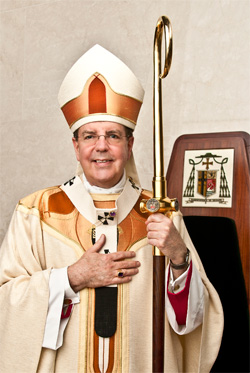
- Archbishop Allen H. Vigneron
The Lord Jesus has been raised from the dead. He has become our peace. Let every heart rejoice.
The great joy of my heart is that through the sacred communion we share in the Eucharist, we are part of each other’s Paschal celebration, no matter in which church we offer Easter Mass. I would also like to be part of your celebration of this great feast of Easter Sunday by offering these few words of reflection on the meaning, the overwhelming significance, of this event. First I will say something about what happened early, before dawn, on that first Easter morning, and then I will speak a bit about why it happened.
What happened? In that very flesh in which Jesus on the cross had died to make a total gift of himself to his Heavenly Father, the Father raised him to a new and all-glorious life. The grave was empty. There is no corpse. There was a corpse from Good Friday afternoon until Sunday morning, but no longer: Jesus lives; not as a ghost or an idea, not merely as a remembrance in our hearts. He lives in the flesh, the flesh in which he suffered and expired, flesh still marked with his wounds, flesh like ours, but now different, since he is filled with divine glory and immortal life. God the Father was well pleased with his self-sacrifice, since Jesus made it with infinite love. The Father consummated his acceptance of this self-immolation by giving the Son life immortal. He poured back into the flesh of Jesus the Holy Spirit, the “Lord and Giver of Life” — that same Spirit that Jesus at his death had breathed into his Father’s hands for safe-keeping. What happened? Jesus won. The devil, sin, and death lost — they lost big.
Why did it happen? For our salvation. God the Father, God the Son and God the Holy Spirit did this for us, worked this great wonder for us. That’s why it happened: so that the sins of the world would be forgiven through Jesus substituting his humble love for the proud self-will that causes sin; so that by enduring suffering and death with unconditional trust, Jesus would transform death and suffering into a means for making a gift of ourselves to God the Father — with, in and through Jesus the perfect Son.
Why did it happen? What I’ve written above is just a sketch of an answer. All the print and electronic media in the world would not suffice as a means to answer this question fully. It is a question that Holy Mother the Church has lovingly thought about long and hard for the last two millennia. (One can find, however, a good summary of the Church’s answer in the Catechism of the Catholic Church, nn. 638-658). And the blessed in heaven will never tire of considering the answer to this “why” question for all eternity.
Why did it happen? I’d like to move toward a conclusion by making one final pass at answering this question. The Resurrection happened so that Jesus could truthfully say, “…All shall be well, and all shall be well, and all manner of thing shall be well.” According to the Medieval English mystic, Juliana of Norwich, the Lord said these words to her while she was at prayer. Obviously they are a beautiful expression of reassurance and offer great consolation to anyone beset by doubts or trials. However, unless Jesus is risen, unless he has conquered sin and death and every other evil for all times and ages, his words to Juliana would be no more than mere words, a sort of nostrum contrived to keep our fears in check. But Jesus is risen. Because of his victory, his words of reassurance are absolutely reliable.
His words to Juliana imply a sort of ellipsis, which I would like to fill out here: “I was dead but I live forever, so ‘all shall be well, all shall be well, all manner of thing shall be well.’”
“Now risen, I am more powerful than all evil and sin, so ‘all shall be well, all shall be well, all manner of thing shall be well.’”
“By my cross I have transformed suffering, even death itself, into a path toward the Father’s eternal embrace, so ‘all shall be well, all shall be well, all manner of thing shall be well.’”
If Christ had not risen, if the sepulcher were not empty, these promises would be hollow cant. But Christ has risen, so his promise that all shall be well is the truest of truths.
My wish is that your trust in the promise of our risen Lord Jesus blossom into joy for you this season. Parents, if you are anxious for the health or well-being of a child, hear Jesus assure you, “I have risen, so all — even this — shall be well.” If you are having trouble at work or even out of work, though you worry, let your worry be tempered by Jesus saying, “I have risen, so all — even this — shall be well.” If you are caring for aged parents, whose daily decline in health leaves no doubt that they are passing toward death, take heart in hearing Jesus say, “I have risen, so all — even this — shall be well.” If you have committed sins beyond number, gravely evil to a degree that causes you to wonder whether there is room for you in God’s heart, take hope, for Jesus is risen and can be relied upon when he says to you, “All — even this — shall be well.”
Until we pass on to the next world, here below we have no closer contact with the risen Jesus than when we receive his living and life-giving Body and Blood at Mass. This Easter, after you accept his gift of his risen Flesh and living Blood in Holy Communion, be sure to pause to listen for him to say to your wounded heart: “All shall be well. All shall be well. All manner of things shall be well. For I live; I will never die again; and in me your life is safe.”
May the Holy Spirit dispel all gloom from your lives and give you joy and hope unbounded in celebrating Christ’s Passover from death to life.
Sincerely Yours in Christ,
The Most Reverend Allen H. Vigneron
Archbishop of Detroit