
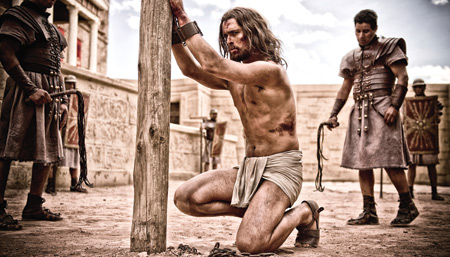
 Jesus is scourged at the pillar in this scene from the 2014 movie "Son of God."
Fox| CNS Photo
In a memorable scene in Spielberg’s Bridge of Spies, Soviet spy Rudolf Abel shares a story with his stalwart American attorney James Donovan, who has defied misunderstanding and opprobrium to defend him in court: “Standing there, you reminded me of the man that used to come to our house when I was young … This one time, our house was overrun by partisan border guards. My father was beaten, my mother was beaten, and this man, my father’s friend, he was beaten. And I watched this man. Every time they hit him, he stood back up again. So they hit him harder. Still he got back to his feet. I think because of this they stopped the beating. They let him live. ‘Stoikiy muzhik’ I remember them saying. Which sort of means, ‘standing man’...”
Abel’s story recalls another “standing man,” Christ, who, in the Passion, rises again and again with increasing difficulty during His brutal scourging. In both these instances, a “standing man” is a man whose inner strength triumphs over external violence.
Standing can also indicate solidarity, and during this last week before Easter, our journey is one of accompaniment. The focus shifts from the 40 days set aside for our repentance to Christ’s self-emptying love that perfumes all of Holy Week. Christ is the “standing man” in His suffering, and we are the “standing ones” at the side of the road to Golgotha and beneath the Cross.
Amidst the busy-ness of our professional and familial lives, we should make it a priority to carve out time just to stand with our Savior, attending the liturgies of the Triduum in order to “be with” Him in prayer. He desires to lock eyes with us, drawing us into His tender gaze as He did Peter, Mary and John.
And yet, we often feel inadequate to the task of “standing with” the Lord. We have not been faithful to our Lenten resolutions; we find ourselves distracted or disaffected during the long readings and prayers of Palm Sunday and Good Friday.
In these moments, we have to recall that even our Standing Man fell. The mission of His life was to redeem us, but, at the moment of the Redemption, He proved unable even to carry the cross alone. What must it have felt like to have His legs crumple beneath Him, to taste the dust of the road? And finally to watch, helpless, as another man was forced to do the job He could not? Simon’s aversion to the repugnant task pounded home more forcefully than hammer thudding on nails how repulsive He was. When we taste our own failure, when we feel shameful and dirty, we are close to Him — not standing but fallen. And He wishes to rise with us and stumble on down the road.
Sr. Maria Veritas Marks is a member of the Ann Arbor-based Dominican Sisters of Mary, Mother of the Eucharist.