


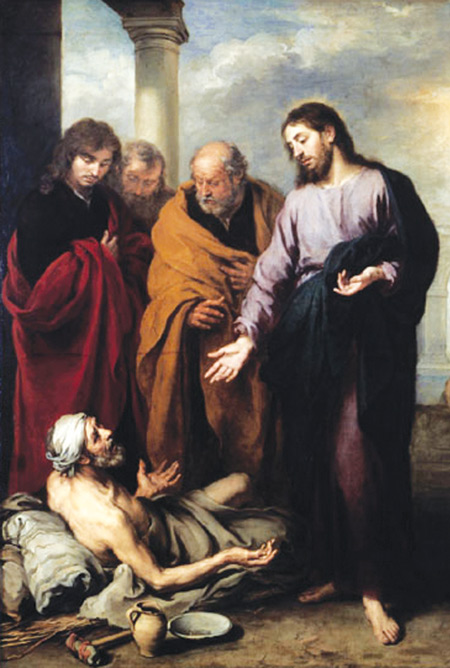
 Jesus heals a paralytic in this classic work by Bartolome Esteban Murillo.
Recently, I was guiding my students through a reflection on an upcoming Sunday Gospel reading (John 1:35-42). In this Gospel, John the Baptist proclaims Jesus to be the Lamb of God, which leads some of John’s disciples to follow Jesus. “Jesus turned and saw them following Him and said to them, ‘What are you looking for?’” (John 1:38a). They expressed the desire to know where the Lord was staying, and He told them, “Come and see” (John 1:39). Just as Jesus called His first disciples at this moment, so also, I pointed out to my students, had they been called to be disciples of the Lord at the moment of their baptism.
What does it mean to be a disciple of Christ? A disciple is one who learns from a master. To learn from the Master, to follow the teacher who is Christ, to throw in our lots with Him, to find in Him the meaning of our lives and our very identity is what it is to be a Christian. To follow Christ means more than simply to follow a set of rules; it is to let Him live His very life within us, transforming us into Himself, other Christs for the world.
Throughout the Gospels, the evangelists record the miracles of healing that Jesus performed. Almost everywhere He went, the Lord would heal those who were sick, suffering, or possessed by demons. In fact, He came to heal our wounded humanity by taking our wounds upon Himself.
I think it can be easy for some of us to think that since we have not experienced traumatic or tragic sufferings in our lives, we have not been wounded. But we all have inherited a fallen nature, wounded though not corrupted by Original Sin. And we all have experienced being wronged by others, whether these injuries are actual or perceived. We all have wounds from which we need to be healed in order to allow God to love us and truly live His life in us.
Jesus healed our wounds by being wounded Himself. Yet He did not seek to hide those wounds or to heal them after He rose from the dead; He still bears these wounds although now they are glorified. It is through the Lord that we learn the possibility and the value of redemptive suffering. Our wounds can bring glory to God and to souls — our own and those of others — if we allow them to be transformed in the power of God’s love, if we allow His love to define who we are rather than our woundedness.
And once we have allowed Him to heal us personally, we will be free to follow Him, to let Him live His own life within us, to be truly His disciples. We will find all that we are “looking for” (John 1: 38), all that we desire.
Sr. Mary Martha Becnel is a member of the Ann Arbor-based Dominican Sisters of Mary, Mother of the Eucharist.



