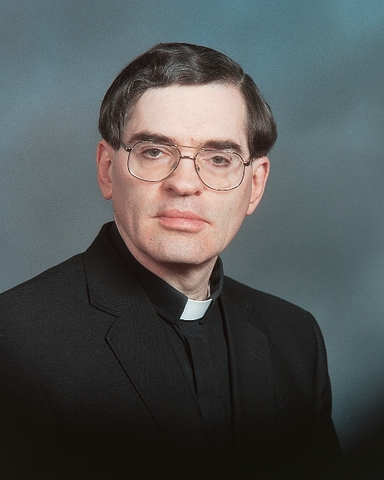
 Fr. Joseph Esper
On Dec. 8, 1854, Pope Pius IX solemnly proclaimed the Dogma of the Immaculate Conception — Catholicism’s formal and unchangeable teaching that the Virgin Mary, uniquely among all the members of the human race, was preserved by God from the very first moment of her conception in her mother’s womb from all stain of original sin.
The pope later confided to a friend that when he began reading the promulgation, his voice was too weak to be heard by the immense crowd in St. Peter’s Basilica (for modern sound systems didn’t exist 158 years ago); however, when he came to the actual words of the dogma, his voice suddenly and miraculously became so powerful it could be heard throughout the basilica. The Holy Father was moved to tears and overwhelmed by an interior vision of Our Lady’s perfect holiness, and later claimed that only a special grace from God kept him from dying of joy at that moment.
Moreover, a ray of light from above illuminated the pope’s tear-stained face — but in fact, as observers later realized, it’s physically impossible for sunlight to pass through any of the windows of the basilica and illuminate the particular spot where Pius was seated that day.
These supernatural signs can rightly be interpreted as indicating divine approval of the Church’s official recognition of Mary’s perfect freedom from sin — a teaching always implicitly present in and consistent with Tradition, but only formally defined in 1854 (after widespread consultation by Pope Pius IX with the Church’s bishops and theologians).
This teaching, of course, is eminently sensible, as a simple analogy demonstrates. If you wished to give your beloved a Christmas gift of exquisite beauty and worth, would you present it to him or her in a simple plastic bag, or carelessly wrapped in newspaper — or would you take pains to offer this gift of complete love in a suitable and beautiful package consistent with its great value?
This is what God did when He sent His Son into the world for our salvation. Rather than allowing Jesus to be born of a sinful mother, He first created an immaculate “package” suitable for Our Lord’s divine perfection. The Catechism of the Catholic Church teaches us that “in order for Mary to be able to give the free assent of her faith to [the archangel Gabriel’s] announcement of her vocation, it was necessary that she be wholly borne by God’s grace” (n. 490). Additionally, the Catechism declares that Our Lady’s unique holiness “from the first instant of her conception comes wholly from Christ: she is redeemed, in a more exalted fashion, by reason of the merits of her Son” (n. 492).
Furthermore, the Roman Missal, in the preface assigned to the Solemnity of the Immaculate Conception, addresses God the Father in these words: “For You preserved the most Blessed Virgin Mary from all stain of original sin, so that in her, endowed with the rich fullness of Your grace, You might prepare a worthy Mother for Your Son and signify the beginning of the Church, His beautiful Bride without spot or wrinkle.”
Thus, in God’s eternal plan of salvation, Mary was to be a foreshadowing, and the foremost member, of the New Jerusalem. The preface for Dec. 8 further states of Our Lady: “She, the most pure Virgin, was to bring forth a Son, the innocent Lamb who would wipe away our offenses; You placed her above all others to be for Your people an advocate of grace and a model of holiness.”
We see, therefore, that Mary’s Immaculate Conception was not solely for her own benefit, but a fitting requirement for the Incarnation (the act of Jesus becoming a human being), and a necessary condition for her role as Mediatrix, or Intercessor, on our behalf.
Our Lady’s intercessory role was widely recognized in the decades before Pope Pius IX’s formal proclamation of the Immaculate Conception, for the so-called “Miraculous Medal” — created as a result of Mary’s request during her apparitions to St. Catherine Labouré in 1830 — bears the words “O Mary conceived without sin, pray for us who recourse to thee.” Indeed, the growing popularity of this devotion was one of the factors that prompted Pius IX to consider a formal declaration of this dogma.
Thus, this great feast has a personal meaning for us: Our Lady’s perfect sinlessness means she is supremely qualified to aid us through her prayers and intercession, and — most importantly of all — to help us find the way to Jesus, her Son. While we cannot hope to imitate Mary’s unique and divinely initiated holiness, her perfect motherly love can inspire us to persevere in our own struggles to accept and use God’s grace ever more fully and humbly. In this way we will be able to join her in proclaiming “the greatness of the Lord” and in rejoicing in God our Savior (Luke 1:46-47).
Fr. Esper is the pastor of Immaculate Conception Parish in Ira Township, and the author of numerous books and magazine articles, including “With Mary to Jesus: Our Surest Path to Heaven” (Queenship Publishing, 2010).