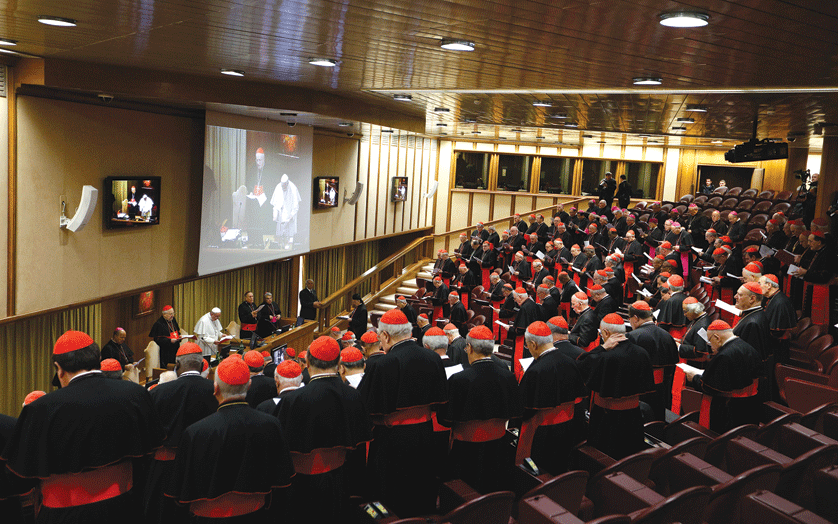
 Fears over the Church changing its doctrine have persisted for millennia and have manifested in various ways, but such thinking seems to doubt Jesus' promise that the Holy Spirit would guide and protect the work of his Church.
 Dave Armstrong
Many Catholics are quite worried about the family synod: thinking it might change the morals of the Church that have been passed-down from the apostles. Seemingly, they lack belief in the indefectibility as well as the infallibility of the Church (both dogmas of the Catholic faith).
In effect, to be anxious in this fashion amounts to a denial that the Holy Spirit guides the Catholic Church. My mentor, the late Jesuit Fr. John A. Hardon, used to say that if a person rejects any dogma of the Catholic faith, he or she loses the supernatural virtue of faith. That’s a frightening thought indeed, and is no small matter.
Remember, “everyone” was “sure” the Church would relax the prohibition on contraception in 1968, too. But what actually happened? We all know: Blessed Pope Paul VI heroically reaffirmed the traditional teaching, despite overwhelming pressure to change it.
Synods, in and of themselves, are not infallible in the first place. They can rise to the level of ordinary magisterial teaching, but only in conjunction with the pope, with his express sanction. Even the ordinary magisterium only applies to teachings that are reaffirmed, that are very well-entrenched in tradition, and can easily be traced back through the centuries.
I would contend that the teachings on marriage and divorce could not possibly change, even according to how Catholic ecclesiology and authority work, before we ever get to considerations of indefectibility and the supernatural protection of the Holy Spirit.
Such a thing would be similar, for example, to the Congress changing some part of the U.S. Constitution at the drop of a hat. They simply can’t do that.
Most sectors of the Church are not existentially burdened with the things dissidents and dissenters concern themselves with (how to change the Church into their own image). They’re not the whole Church. Folks need to stop thinking that they are, just because they make a lot of noise.
The dissidents tried to hijack Vatican II and foist upon millions of Catholics the notion that the Catholic Church had magically transformed itself into the internal and perpetual chaos that is Anglicanism. Consequently, millions lost faith or became compromised in serious ways. But the Catholic faith had not fundamentally changed at all.
The dissenters couldn’t even pretend that Humanae Vitae in 1968 and the affirmation of the age-old prohibition of contraception was a “victory,” and so consequently almost split off. The possibility of wholesale schism of millions was very real in those days.
Our faith and trust is in God, not in some fancy that Catholics will all be perfect saints at all times. There have always been sinners and corruption in the Church, yet true doctrine has (quite remarkably) been passed down all these years.
No one need take my word alone for that. Just read 1 and 2 Corinthians, Galatians, and Jesus’ warnings to the seven churches of Revelation.
Even the writers of the New Testament were great sinners. St. Paul murdered Christians, St. Peter denied Christ three times and was a hypocrite to such an extent that Paul rebuked him (an incident itself captured in Scripture). All the disciples save one fled from Jesus when He was tried and crucified.
Doubting Thomas continued to doubt, despite all the miracles he had seen Jesus perform. Finally he threw in the towel and ceased his ludicrous doubting (at least temporarily), when Jesus appeared after His resurrection, just for him, and told him to touch the wound in His side.
But I highly suspect that he continued to doubt other things after that. Some folks are — by constitution or temperament — worriers; anxious types, and will keep worrying no matter what. But they should at least keep these things to themselves.
There is nothing new under the sun, as Ecclesiastes 1:9 teaches. Those who think things are uniquely bad now have not read much Church history.
Let’s briefly look at two horrible periods. One was the fifth century, when the heresies of Arianism (Jesus as a mere creature) and Monophysitism (Jesus supposedly in possession of only one nature rather than two: divine and human) were very rampant. Blessed John Henry Cardinal Newman wrote about this time:
“Such was the state of Eastern Christendom in the year 449; a heresy [Monophysitism], appealing to the Fathers, to the Creed, and, above all, to Scripture, was by a general Council [the “Robber Council”], professing to be Ecumenical, received as true ...
“Dreary and waste was the condition of the Church, ... the whole of the East [in 493] was in the hands of traitors to Chalcedon, and the whole of the West under the tyranny of the [Arian] open enemies of Nicaea ...” (An Essay on the Development of Christian Doctrine, 1845; 6th ed., 1878).
Things were almost as bleak in the late 15th century. Catholic theologian Karl Adam described the corruption of popes during this era as follows:
“[T]he Renaissance Popes seem to have carried out in their own lives that cult of idolatrous humanism, demonic ambition and unrestrained sensuality” (The Roots of the Reformation, translated by Cecily Hastings, New York: Sheed & Ward, 1951 p. 14).
He quotes the words of Pope Adrian VI (1522-23), who in turn cited St. Bernard, from a completely different era (12th century):
“Vice has grown so much a matter of course that those who are stained with it are no longer aware of the stink of sin” (Ibid., p. 20).
- K. Chesterton once noted that the faith had gone to the dogs five times, and in every case the dog died. We’re about to witness, once again, another dog dying.
Dave Armstrong has been a full-time Catholic apologist since 2001. He lives in Allen Park, grew up in Detroit, and attends St. Joseph Church near downtown. He has been happily married to his wife Judy since 1984, and they have four children. Dave has written 44 books on various apologetics topics, including five for Sophia Institute Press, and several bestsellers in the field. These are available for purchase (ePub, mobi, or PDF) at his deep discount book site, www.biblicalcatholicism.com, and in paperback elsewhere.