

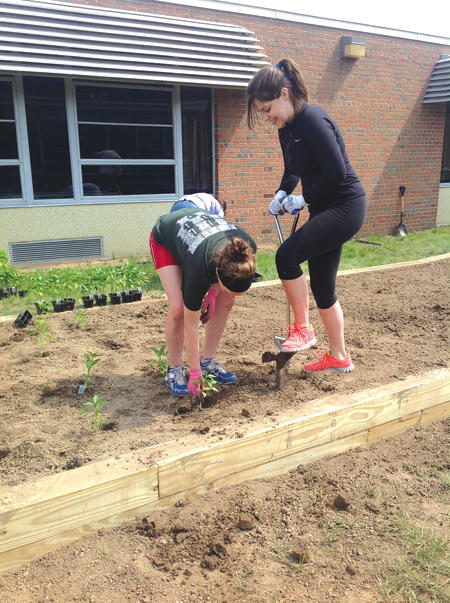
 Ladywood students till the soil in the school's community garden, which will be used to help supply soup kitchens as well as prepare school lunches.
Livonia — At the heart of a school that sits on Newburgh Road in Livonia is a garden built with hope, forged with dreams and tilled with prayer. Today, it serves the community and feeds the poor, and it’s just getting started.
The community garden at Ladywood High School became a reality two years ago, but it’s been years in the making. It would have remained a dream if not for the vision, hard work and prayers of teachers Mike Gaule and Joyce Brouillette.
“It’s been several years in the making,” said Gaule, who teaches environmental science at Ladywood. “I took a class in earth partnership for schools, and the rest is history.”
Gaule and Brouillette took the class through the University of Wisconsin, following up their vision to implement the garden as a sustainable environment. Gaule was careful to point out that his vision was directly in line with Pope Benedict XVI’s writings on the earth, water and the environment.
Gaule and Brouillette’s work came to fruition some time later with the help of an $8,500 grant from the Felician Sisters’ St. Francis Stewardship Fund and upwards of $15,000 in donations from a Ladywood High School benefactor.
The garden was designed to show solidarity with the poor, one of the core values of the Felicians, who sponsor Ladywood High School, Gaule said. The garden is to be self-sustaining, and eventually it will thrive directly via rain water, as Gaule has developed a rain catch basin to keep the garden hydrated during the hot summer months.
The brainchild of both Gaule and Brouillette, the garden was born from a concern for the poor, for the environment, and a desire to serve both. There are actually two gardens, the largest of which is nearly 600 square feet; the smaller of the two is around 400 square feet. They both rest adjacent the school’s main hallway and are visible by students and faculty alike as they stroll the halls. During the fall and spring, Gaule regularly invites people to participate in its upkeep — usually bribing them with some free vegetables.
So, what does it grow? You name it: Strawberries, asparagus, tomatoes, peppers, onions and squash. And don’t forget about the herbs. Want some sage, parsley or basil? All likely favorites of St. Francis, and all grown to help serve the community. What was that core value again?
When asked how easy it’s been to keep wild animals from helping themselves to the delectables, Gaule quipped: “We had some regular visitors, until we put up our scarecrow.” At the end of a row of strawberries sits a makeshift mannequin, strategically facing the woods behind the property. Gaule reports she seems to have taken care of the problem.
Perhaps the most satisfying thing about the garden is the people who benefit from it. In addition to being used to help prepare school lunches, the food goes to Forgotten Harvest, which helps supply the Capuchin Soup Kitchen in Detroit, where the father of Ladywood’s own admissions manager Emily Nemeth works.
The Felician heritage has always been about serving God by serving the community. At its core, the community garden is a small way to fulfill that, and to do it in a way that recognizes our home as a gift from God and our blessings as things meant to be passed on.
In the words of St. Francis of Assisi, “if we can implore God to hear our prayers, how careful we should be to grant the petitions of our neighbors in need.”