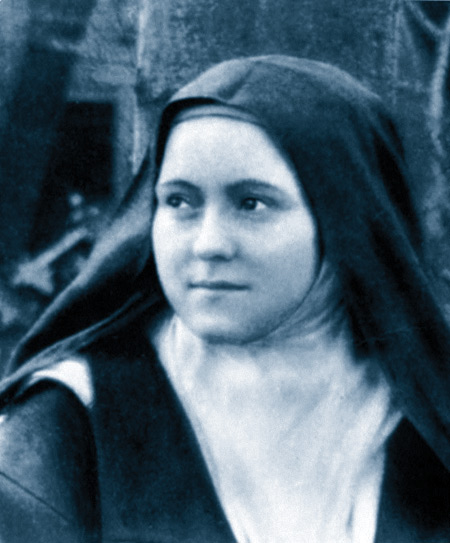
 St. Therese of Lisieux, the Carmelite nun known as the "Little Flower,"is seen in this 19th century photograph.
Recently I was teaching young children about baptism during a week of Vacation Bible School. The children’s faces shone bright with amazement as they learned that their baptism was the moment that they became children of God and that God came to live within them. God’s life is within us, making us His children, because of the sanctifying grace we receive at our baptism. Can there be anything more marvelous than the fact that God desires to give us a share in His life, not only in heaven but even now on earth?
Of course, this participation in God’s life does not free us from being weak and imperfect in this life. When St. Paul was suffering from some “thorn in the flesh” that he could not overcome, Our Lord told him, “My grace is sufficient for you, for power is made perfect in weakness” (2 Corinthians 12: 7, 9). Grace does not free us from flaws, because we still suffer the effects of Original Sin, but if we cooperate with this gift, it will free us to recognize what is most important in life and to live for God rather than for ourselves.
God can and does use our weaknesses and imperfections for His greater glory. The saints were well aware of this truth. St. Paul boasted of his weakness, and St. Therese rejoiced in her littleness, stating, “When we keep little, we recognize our own nothingness and expect everything from the goodness of God, exactly as a little child expects everything from its father.” Paul, Therese, and all the saints knew that they did not have to be something great in and of themselves. Rather, they had to allow the power of God’s love and grace into those weakest places of their lives. It is in those places that we are able to discover most clearly that God is the one who is in control; it is in our weakness, not in our personal strengths or in “having all our ducks in a row,” that we are able to recognize our need for and dependence upon Him.
Is living in God’s grace enough for us? Or do we seek our happiness in lesser things — in success or popularity perhaps? Or in a desire to be perfect or never make mistakes? Or in needing always to be right or have the final word? But we do not find God’s power in those things; we find His power in those areas of our lives in which we must surrender control to Him. God’s grace will become truly sufficient for us, and His power will be most at work in us, when we are willing to admit humbly that our greatest need and our deepest longing is for Him.
Sr. Mary Martha Becnel is a member of the Ann Arbor-based Dominican Sisters of Mary, Mother of the Eucharist.