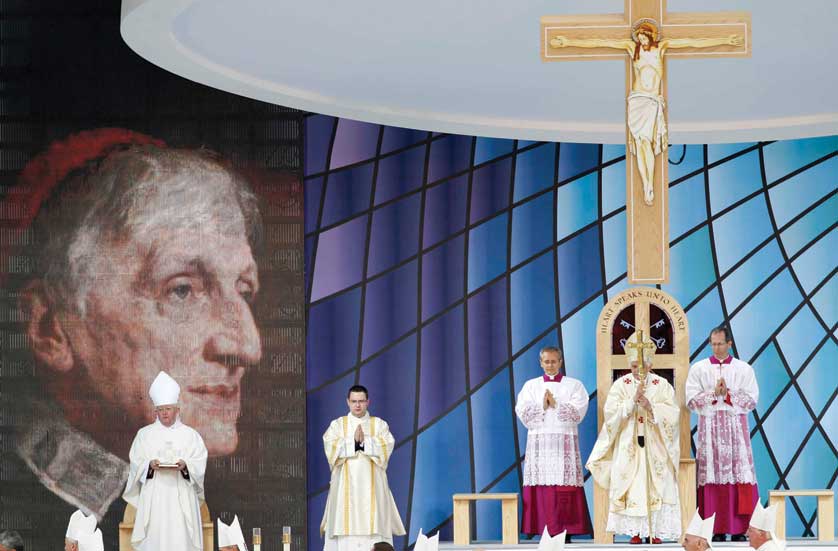
 Pope Benedict XVI leads Mass and the beatification of Cardinal John Henry Newman at Cofton Park in Birmingham, England, Sept. 19. Blessed Newman, a 19th-century theologian and a prolific writer on spiritual topics, left the Anglican Church and embraced Catholicism at the age of 44. An image of Blessed Newman appears at left.
(CNS photo/Andrew Winning, Reuters)
The Catholic Church holds that our Lord Jesus Christ delivered one apostolic deposit to His apostles, and that it hasn’t changed in terms of essence or substance. The Catholic Church preserves it, and is its guardian. But there is a growth in depth of clarity, in the understanding of those truths, without essential change.
In other words, the Church’s subjective grasp of doctrines has increased through the centuries, without doctrines or dogma changing in an essential way. Development is not evolution (where a thing changes to something else).
I think anyone familiar at all with the Bible would recognize immediately that the book of Genesis is a lot different from reading, say, John or Colossians. Obviously a great development of the thought and the theology has taken place.
As an illustrative example, let’s examine the doctrine regarding faith or salvation. If we go back to Abraham, we observe the Abrahamic Covenant, which basically is Abraham believing in God, and as it says in the Bible, it is “reckoned unto him righteousness.” Moving on from there, the notion of the chosen people (the Jews) is somewhat like election, as we Christians say, or enabling grace from God. In other words, it’s unmerited. God chose them and gave them grace for His purposes.
Examples of development
Moses’ receiving the Law and the commandments from God was a key development in salvation history. Further progression occurred with the eternal covenant made by God with King David, and in the belief in a Messiah. These things are also sometimes known as “progressive revelation.”
Isaiah 53 presents the “suffering servant.” To my knowledge, that’s the first indication of what actually happened to Jesus on the cross (apart from a few indications here or there, such as Psalm 22). All of this is development: all the way through the Old Testament, to the Gospel being announced, with John the Baptist and Jesus Himself. Even then, Jesus said, “I came not to change the Law but to fulfill it.”
Christology is another area of theology that underwent great development; in this instance, after the period of the Bible. On my website (and in two of my books), I present a lot of Scripture that, I believe, offers evidence of the Holy Trinity and the Incarnation and divinity of Jesus Christ.
All of this data has to be painstakingly “collected” and systematically put together. It doesn’t jump right out at us from Scripture. For that reason, the Church had to develop it — and usually in response to heresy.
When the Church pondered the nature of Mary, it proclaimed at the Council of Ephesus in 431 that Mary was the “Theotokos,” which means “Mother of God.” This was one of many examples of a response to the false claims of heretics. The Nestorians, for instance, held that Mary was “Christotokos” — the mother of Christ, but not of God. The Church then reflected upon it, and ruled against it. That whole process is development of doctrine, as well.
Christology was further elaborated upon 20 years later at the council of Chalcedon in 451. It promulgated the dogma of the two natures of Christ, or what is called the “Hypostatic Union,” where Jesus is God and man, with no separation. This was in response to the Monophysite heresy, which held that Jesus had one nature only.
Learning through the ages
It’s difficult to locate an explicit biblical passage specifically “defining” doctrinal development. I defend it as “biblical” in the way I did above: by showing that the Bible itself develops; therefore the Church is merely continuing that process of developing thought.
I submit that a few passages, however, suggest development, like the parable of the mustard seed (Matthew 13:31-32): where the kingdom of God is like this small seed that grows into a huge tree. The Body of Christ in Scripture is presented as a living organism; therefore it grows (an increase of understanding).
In John 14:26 and 16:13; Jesus says that the Holy Spirit “will lead you into all truth.” The Church learns things through the ages. Theological or spiritual knowledge did not cease to grow or expand after the apostles. We still reflect upon doctrines today. In recent decades, for example, ecumenism and the theology of the body have been greatly developed.
The canon of Scripture itself was an instance of development over some 350 years. The Bible we have today was finalized only in 397 at the Council of Carthage. The books of Hebrews, James, 2 Peter, 2 and 3 John, Jude, and Revelation were not widely accepted by the Church until 350 A.D.! On the flip side, some prominent Church fathers held that some books were Scripture that later weren’t selected for the canon, such as the epistles of Barnabas and Clement. Of the 27 New Testament books, 14 were not mentioned at all until around 200 A.D., including Acts, 2 Corinthians, Galatians and Colossians.
A small ‘Catholic tree’
When I was an evangelical Protestant back in the 80s, I used to picture the Church as a ship, and tradition, analogically, as the barnacles underneath the ship. We get rid of barnacles, and scrape them out. But true apostolic tradition is, rather, the rudder of the ship, or the guiding principle of the Church, as it passes through the “sea of history,” so to speak.
Development of doctrine is the principle of a living, breathing tradition, guided by the Holy Spirit, and also the consciousness of the Church as a whole. Today’s Church shouldn’t be expected to look like the primitive Church if it is a living, vibrant, spiritual organism. But even the early Church looked like a small “Catholic tree.”
Hence, Cardinal Newman, when he was an Anglican Church historian, wrote to his sister Jemima on Nov. 17, 1839:
“I cannot deny that from the first the Fathers do teach doctrines and a temper of mind which we commonly identify with Romanism.”
Newman’s intensive study of development of doctrine a few years later led him to the Catholic Church, and my reading of his famous “Essay” on the topic led me to the Church, too, in 1990.
Dave Armstrong has been a full-time Catholic apologist since 2001. He lives in Melvindale, grew up in Detroit, and attends St. Joseph Church near downtown. He has been happily married to his wife Judy since 1984, and they have four children. Dave has written 44 books on various apologetics topics, including five for Sophia Institute Press, and several bestsellers in the field. These are available for purchase (ePub, mobi, or PDF) at his deep discount booksite, www.biblicalcatholicism.com, and in paperback elsewhere.