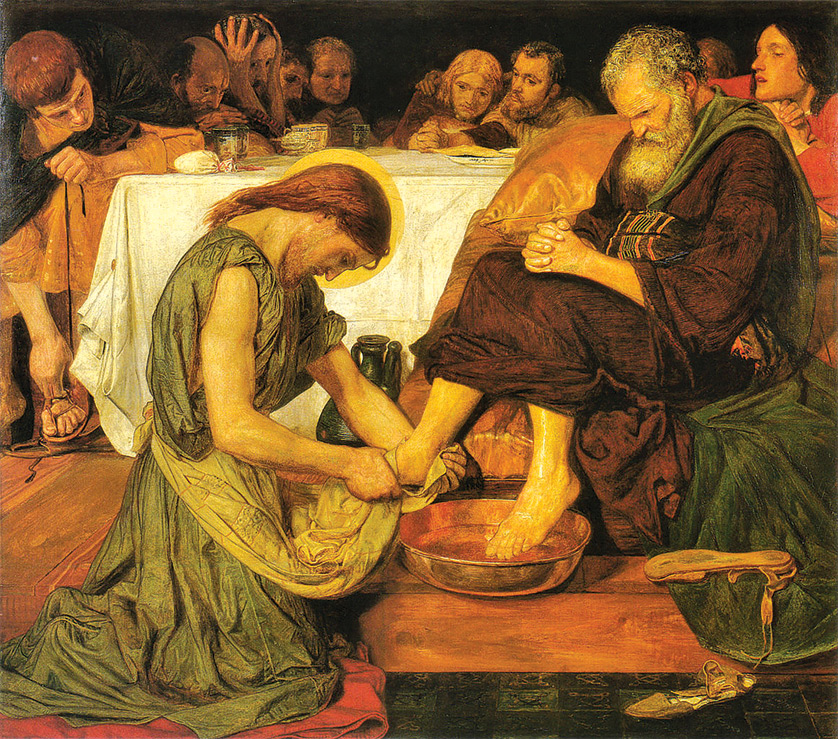
 Jesus washes Peter's feet in this 1856 painting by Ford Madox Brown. When Jesus gave Peter the authority to "bind" and "loose," he was giving him an authority that was well understood in the Jewish synagogues at the time.
More ink has been spilled by scholars on Matthew 16:16-19 than perhaps any other passage in the New Testament, and for good reason. It is the passage in which Jesus makes Simon the “rock” upon which He will build His future Church, thus making it a good proof for the primacy of the pope, the successor to the chair of Peter.
In previous articles, we looked at the biblical background behind Simon’s name change and the “keys of the kingdom of heaven.” We haven’t looked, however, at an oft-ignored but equally illuminating proof text in the same passage, namely, the bestowal of the power to “bind and loose.”
In Matthew 16:19, Jesus says to Simon Peter, “I will give you the keys to the kingdom of heaven. Whatever you bind on earth shall be bound in heaven; and whatever you loose on earth shall be loosed in heaven.”
What does “bind” and “loose” mean? These terms come, not from the Old Testament, but from the synagogue. Binding and loosing are rabbinical terms that mean the power to place the community under obligation (i.e., “to bind”) or the release the community from an obligation (i.e., “to loose”). The terms equally apply to doctrinal matters (e.g., declaring what is true doctrine) as well as to disciplinary decisions (e.g., banishing someone from the community or allowing them back).
By applying these terms to Simon Peter, Jesus is investing him with jurisdictional authority over His Church. More than that, Peter’s authority to bind and loose is sanctioned from heaven. Whatever Peter binds on earth shall be bound in heaven,and whatever he looses on earth shall be loosed in heaven.
The Jewish background to these words also singles out the uniqueness of the authority given to Peter. During the time of Jesus, the pastoral care for the Jewish people centered on the local synagogue. The rabbi had authority to bind and loose local decisions. However, there was a higher, broader authority, which was known as the Great Bet Din (or “House of Judgment”).
According to the JPS Guide to Jewish Tradition, “...the Great Sanhedrin exercised sweeping judicial, legislative, and executive powers and was the only court that could try ‘a tribe, a false prophet, and a Kohen Gadol (High Priest)’ (Sanh. 1:5)...” Although local rabbis had the power to bind and loose, the president of the Great Bet Din alone had the ultimate authority to bind and loose in matters of doctrine and disciple.
If Judah the Prince (R. Yahudah ha-nasi), a rabbi who lived in the second century A.D., tells us anything about the role of the “president” of the Great Bet Din, he shows us that the president was more than an administrator. He was a patriarchal figure who could create new law by personal decree. In fact, Judah the Prince is accredited with finalizing the Jewish oral law known as the Mishnah.
Given this background, it seems likely that Jesus’ promise of the “keys of the kingdom” and the power to bind and loose makes Simon Peter both the prime minister of Christ’s kingdom and the
 Gary Michuta
president over the Christian community, respectively, since both were associated with the special prerogatives of these officers.
A common rejoinder against any special authority given to Peter is that Jesus also gives the power to bind and loose to the rest of the apostles in Matthew 18:18, so Peter receives nothing special. The problem with this is that Simon Peter actually receives this power twice, once in Matthew 16:19 and again in Matthew 18:18. Why?
I believe the different contexts in both passages offer us a solution. In Matthew 16, Jesus is talking about “my Church” — that is, the Church as a whole. In Matthew 18:15-18, Jesus is addressing the reconciliation of a sinner with a local Church, where the local bishop would have jurisdiction. If this is correct, then Jesus giving the same authority twice makes sense, because the pope has jurisdiction over the whole Church, and he is also the bishop of Rome. He has universal jurisdiction and local jurisdiction, where the rest of the Apostles (and their successors) would have only local jurisdiction.
Gary Michuta is an apologist, author and speaker and a member of St. Michael the Archangel Parish in Livonia. Visit his website at www.handsonapologetics.com.