
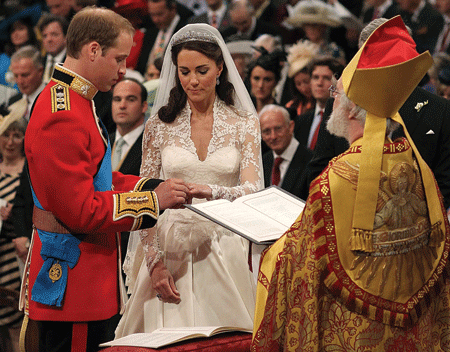
 Britain's Prince William and Kate Middleton exchange rings during their wedding ceremony in 2011.
Dominic Lipinski | CNS Photo
“Have courage and be kind.” With these words, Cinderella’s mother bids a final farewell to her young daughter in Disney’s latest version of the classic story. As the movie unfolds, Cinderella clings to this counsel, treating the creatures of home and garden with gentleness, sacrificing her own preferences to her father’s dreams of happiness with a second wife, doing her best to see the good in her new stepmother and sisters, and swallowing her pride again and again in the face of their hostility. The absurdity of her stepmother’s conniving a royal marriage for one of her own daughters becomes increasingly apparent to the viewer, who discovers in Cinderella alone the nobility of character that makes her a fit consort for the prince.
The tale of Cinderella — or the marriage of a Prince William to a Kate Middleton — fascinates us because of the desire hidden within each of us to be something great. The good news of the Gospel is that God wishes to fulfill that desire. In baptism, we are adopted by the King of kings, made “heirs of the kingdom” and brothers and sisters of the Prince (Romans 8:17). We are also given all the divine help we need to become holy, to rise to the dignity accorded us.
Nobility in the secular realm has traditionally been governed by the principle that noblesse oblige: the unearned privilege of noble birth carries with it heavy responsibilities of generosity and thoughtfulness. Similarly, our divine adoption is a free gift that requires us to act with nobility of soul. Cinderella governs no earthly domain — except, perhaps, the attic to which she is relegated by her malicious family members — but she reigns over her emotions and her will, exercising both kindness and courage when each is required. To this we, too, are called.
I have been teaching my high schoolers about the virtues; when I asked them, a few days after a lesson on courtesy, whether they had recently witnessed any exercise of virtue, one responded: “I was on a road trip with my family, and, when we arrived, my cousin walked around the car to open the door for me.” She smiled as she relished the memory, emboldening me to ask, “How did that make you feel?” She paused, then said softly, “Like a princess.” And so she is, a daughter of the King, and her cousin is a prince. When we practice virtue, our actions bespeak the truth of our royal birth.
Sr. Maria Veritas Marks is a member of the Ann Arbor-based Dominican Sisters of Mary, Mother of the Eucharist.