
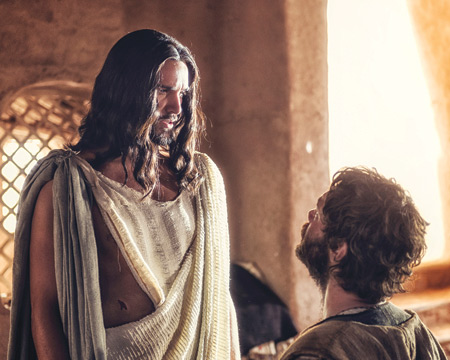
 Juan Pablo Di Pace, as Jesus, and Johannes Haukur Johannesson as Thomas, star in a scene from the 12-part NBC-TV series titled "A.D. The Bible Continues," currently airing Sunday evenings. (CNS photo/NBC) See ACTS April 14, 2015. Editors: for editorial use only.
During the 40 days following Easter, Christ wove the glorious thread of His presence into His disciples’ daily lives, passing through locked doors to stand among them, treading the dusty road between Jerusalem and Emmaus, bending over a charcoal fire on the shore of Lake Galilee. His message was always the same: I am alive, you are witnesses, and, when I have ascended to heaven, you will testify publicly with the Spirit’s power.
To each of us, too, He says, “You are witnesses.” We have not seen the risen Lord with our physical eyes, but, through our baptism and confirmation, we have received the eyes of faith and the assistance of the Holy Spirit and have been made communicators of the truths handed on to us.
Who are witnesses? Pope Francis defines a witness as one who sees, remembers and recounts. These categories express the three elements of the Christian life: encountering Christ, cultivating friendship with Him, and living our friendship in speech and action. The Greek word for “witness” transliterates back into English as “martyr,” reminding us that the greatest witnesses to Christ are the martyrs, whose friendship with Him ran so deep that “love for life did not deter them from death” (Rev 12:11).
 Sr. Maria Veritas Marks, OP
The martyrdom of St. Peter of Verona, a 13th-century Dominican, ranks among the most evocative in all Christendom’s annals. The Albigensian heretics against whom he so spiritedly and successfully preached finally hired assassins to silence him. Ambushed on the road to Milan, Peter sustained an axe-blow to the head and, as he lay dying, traced with his blood on the ground the Latin word credo, “I believe,” the beginning of the Creed, thus expressing with words what his death proclaimed so eloquently without them.
Francis Cardinal George of Chicago famously declared, “I expect to die in bed, my successor will die in prison, and his successor will die a martyr. His successor will pick up the shards of a ruined society and slowly help rebuild.” Whether or not martyrdom lies in our future, credible witnessing to Christ must characterize our daily lives now. Small acts of self-denial and of virtue show others Who reigns in our hearts. It was Peter of Verona’s life, a life of humble obedience, courageous preaching and fervent prayer, that prepared him for the death God asked of him.
This month, as we celebrate our earthly mothers and our heavenly Mother, the words of Salvadoran Archbishop Oscar Romero, himself a martyr, resonate with particular force: “We must all be prepared to die for our faith, even if the Lord does not do us this honor … Giving one’s life does not just mean dying; giving one’s life, being martyrs, also means giving life gradually, in prayer, in the honest fulfilment of one’s duty, in the silence of everyday life,” like a mother who, “with the simplicity of motherly martyrdom, conceives a child in her womb, gives birth, nurses, raises and cares for him or her with affection. This is giving life. This is martyrdom.”
Sr. Maria Veritas Marks is a member of the Ann Arbor-based Dominican Sisters of Mary, Mother of the Eucharist.