
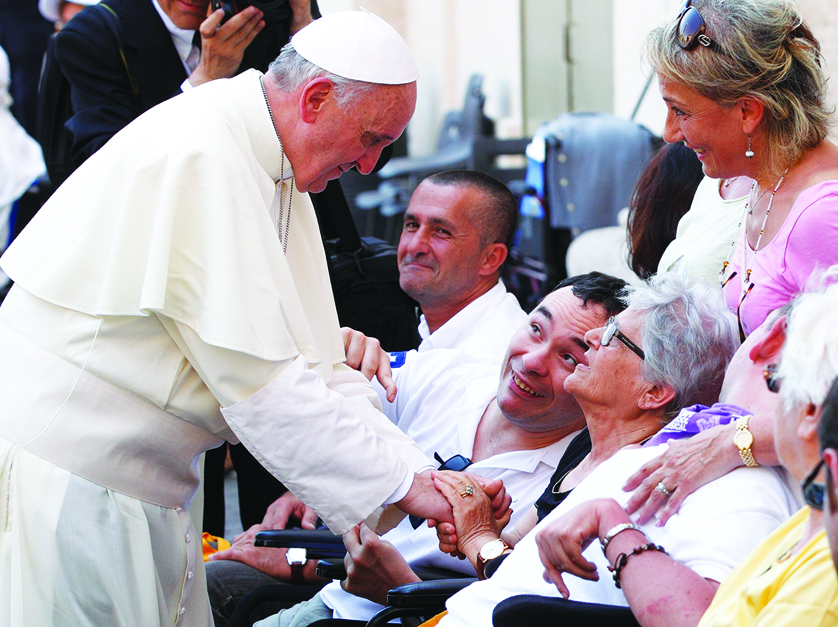
 Pope Francis greets people in wheelchairs after celebrating Mass in St. Peter’s Square last summer.
During Lent, the Liturgy of the Hours, prayed daily by priests, religious and many laity, places before us again and again St. Paul’s exhortation: “Brothers, I beg you to offer your bodies as a living sacrifice, holy and acceptable to the Lord” (Rom 12:1).
These words echoed in my mind as Pope Francis told those attending his weekly audience on March 4: “We old people are all a little fragile. Some, however, are particularly weak, many are alone, and stricken by illness. Are we going to abandon them to their fate? A society without proximity, where gratuity and affection without compensation is disappearing, is a perverse society.” Key to fostering proximity and gratuitous affection toward the vulnerable is the recognition of our own vulnerability, a recognition facilitated by our practices of Lenten penance.
As Pope Francis explained, the elderly “are abandoned out of a selfish incapacity to accept their limitations that reflect our own limitations.” The elderly hold up to us a mirror, reminding us that, even if exteriorly fit and independent now, we are actually as frail as they interiorly. Wounded by sin, we have to struggle to attain virtues that should come easily. And we are creatures, finite, limited, dependent upon God’s loving providence. This creatureliness should be embraced, not repudiated, but in our fallen state we prefer the lie of self-sufficiency to the truth of reliance on God.
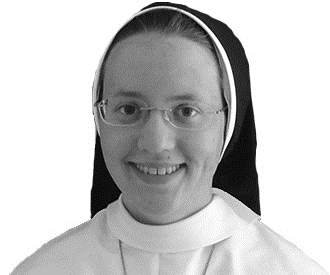
 Sr. Maria Veritas Marks, OP
Here is where Lent can help us: “Remember, thou art dust,” we hear as our foreheads are marked with the Cross on Ash Wednesday. The mortifications we undertake during Lent, the inconveniences attendant upon almsgiving, the heightened efforts to root out bad habits — all these permit us to recognize and express externally our interior fragility, our solidarity with the weakest and most vulnerable of our neighbors. Ultimately, it is a union with the crucified Christ, pinioned to the Cross, wracked by pain, subject to the spitting and jeers of those below, unable to shield those He loved from the anguish and ignominy.
We tend to marginalize the weak because they remind us of our own weakness, but we forget that “when I am weak, then I am strong” (2 Cor 12:10). St. Paul could “glory” in his weakness because it was in his moments of profoundest weakness that he was forced to rely on God, and God supplies our every lack. When we pretend to autonomy, we are left with only our own puny efforts; if we depend on Him who strengthens us, we “can do all things” (Phil 4:13).
St. Therese of Lisieux leaves us with a lovely image: like tiny tots trying to climb a staircase, we lift our little feet determinedly but in vain. Our Father, standing at the top of the staircase, sees our feeble attempts and, moved by our inability, runs down, sweeps us up in His strong arms, and carries us upward. Let us allow Him to do that this Lent.
Sr. Maria Veritas Marks is a member of the Ann Arbor-based Dominican Sisters of Mary, Mother of the Eucharist.