
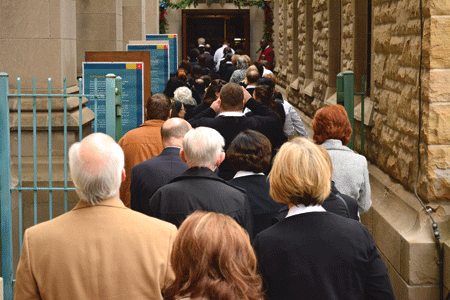
 Pilgrims make their way through the Holy Door at the Cathedral of the Most Blessed Sacrament in Detroit.
Mike Stechschulte | The Michigan Catholic
“When April with its sweet-smelling showers / Has pierced the drought of March to the root … Then folk long to go on pilgrimages.” So begins Chaucer’s 14th-century Canterbury Tales.
Pilgrimage used to constitute a familiar thread woven into ordinary Christian life. The faithful regularly undertook journeys to holy sites to thank God for blessings or to make reparation for sins. Yet today, pilgrimage is rare.
A gathering of Catholic educators I recently attended began with a quiz gauging our knowledge. One question asked: Which of the following has the pope asked of us during this Jubilee Year of Mercy? The answers were read aloud: (a) make a trip to a Holy Door, (b) carry out the works of mercy, (c) accept all lifestyles without question, (d) both (a) and (b), (e) none of the above. When (a) was read, many of the teachers chuckled, as if this were clearly as absurd an answer as (c). They must have been shocked to learn that the correct answer was (d).
Why did pilgrimage strike them as silly? The bodiliness of pilgrimage flies in the face of our technologically advanced age. We think we have moved beyond the need to engage our bodies in the work of our souls. But the medieval's understood a truth that we moderns forget or ignore: humans are precisely embodied souls. My body is not a shell to be shed or transcended but an integral part of my journey to God, something without which I am humanly incomplete and something that I will receive back, in glorified form, on the Last Day, to enjoy forever in eternity.
On Good Friday this year, some sisters and I joined a six-hour walking pilgrimage along which the Stations of the Cross were enacted. By day’s end, footsore and spent, we nonetheless found ourselves somehow deeply fulfilled. Upon reflection, I realized that the physical exhaustion gave external expression to the emotional exhaustion that usually characterizes Good Friday. Normally, as we accompany our anguished Lord in spirit, our bodies are quietly sitting or kneeling. The pilgrimage, by contrast, offered our bodies the opportunity to participate in the emotional journey, and the result was a fitting unity of body and soul.
Along the pilgrimage, our group, mainly college students and young adults, encountered many interesting characters. One vagrant stood transfixed upon a street corner as we passed, and we later discovered him among our ranks: he had apparently been moved to join us. Although not entirely sound physically or psychologically, he trudged along without incident or complaint, watching the Stations with rapt attention. His presence provided a powerful visual reminder that all of us are, in some way, wounded and ill, and that God welcomes each of us into the pilgrimage toward Himself, surrounding us tenderly with all the necessary helps.
During this Year of Mercy, then, consider making a pilgrimage to the site of a Holy Door in your diocese. You will experience God’s mercy in ways you never expected and live fully the truth of your embodied humanity.
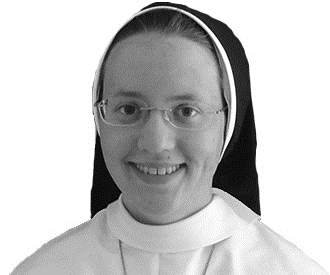
Sr. Maria Veritas Marks is a member of the Ann Arbor-based Dominican Sisters of Mary, Mother of the Eucharist.