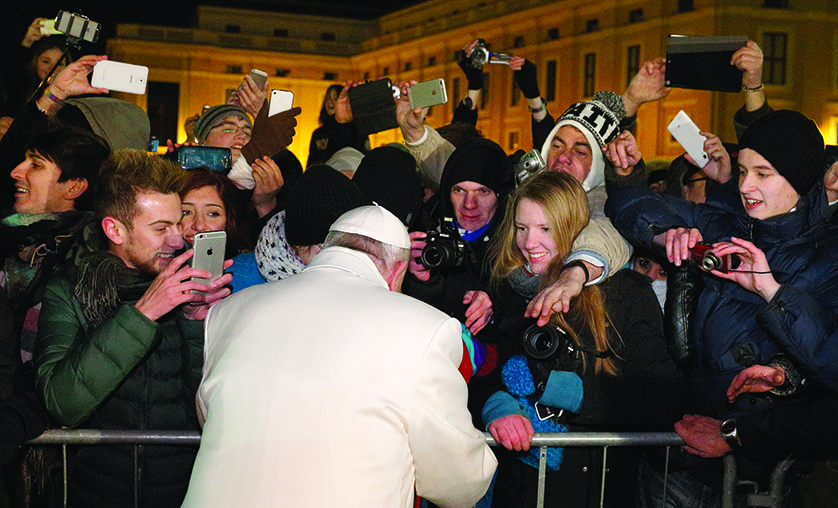
 Pope Francis greets people after visiting the Nativity scene in St. Peter's Square after a New Year's Eve prayer service in St. Peter's Basilica at the Vatican. (CNS photo/Paul Haring) See POPE-YEAREND Dec. 31, 2014.
As any conscious person who follows Catholic affairs at all knows there seems to be a constant uproar and “buzz” about this, that, or the other thing that the Holy Father said. One of my friends claimed that Pope Francis’ shortcomings were the cause, and asked my opinion about it. The following was my reply (expanded for this article):
1.) I think (with all due respect and deference) that the pope would benefit and help things by being more careful in his public statements, knowing that they have been systematically misrepresented.
2.) The pope could (preferably) be more articulate and verbally careful, even given the fact that this aspect is greatly over-exaggerated.
3.) That said, the division and confusion has been cultivated primarily (beyond the causes in No. 1 and No. 2, wherever they occur) by media misrepresentation, fueled enormously by heterodox, modernist, so-called “progressives” in the Church, as well as quasi-schismatic radical Catholic reactionaries on the far right. The former seem to love these misrepresentations, which imply that Pope Francis is a theologically liberal revolutionary, while the latter despise these distortions for the same reason.
4.) Because the above scenario has been relentlessly occurring these past three years, now many others have jumped on the “bandwagon” because of the false (or at best grotesquely distorted) “narrative” about Pope Francis, so that now, many legitimate traditionalists and even non-traditionalist orthodox Catholics are bashing the pope or criticizing him on a regular basis.
While some of the criticism (given in charity, of course), might be legitimate responses to scenarios No. 1 and No. 2, the vast majority is patently unfair to the pope.
As a full-time apologist, I have defended Pope Francis for more than three years and have seen firsthand how much distortion has taken place — how many “bum raps” this pope truly does get. I wrote a book about it two-and-a-half years ago (Pope Francis Explained), and I’ve seen no reason to change my opinion in the interim.
My book only touches the tip of the proverbial iceberg. I have also compiled 250 articles, as of writing, defending or explaining things the pope has said or done — or supposedly said or did (“Pope Francis Defended: Resources for Confused or Troubled Folks,” on my (Patheos) site, or with a simple word search).
I’ve studied many of these claimed instances of error in depth, close-up. And at least in most of the instances I’ve studied, I don’t believe the pope was at fault. In the few cases where he might have been, I don’t think it was nearly as serious as folks made it out to be.
Generally, the false accusations will fall under one of three categories: 1.) wildly taking the Holy Father’s words out of context (“Who am I to judge?” is the classic example), 2.) misinterpreting them by not understanding the genre (which happens to the words of Jesus all the time; such as people taking his hyperbole literally), and, 3.) outright mistranslation of the Italian language.
Simply put, the vast majority of the criticism out there is illegitimate. If in fact (as I contend) the criticism is wrongheaded, mistaken, factually out to sea, etc., then spreading such charges around is scandalous, especially as it regards the pope.
As such, everyone has a choice to make: whether to listen to the slant of the secular media and those on the far right and left wings of the theological spectrum, or at least to take into consideration defenses of the Holy Father, written by orthodox Catholics, who accept his authority and charism from God.
Blessed John Henry Cardinal Newman (the man most responsible for me becoming a Catholic), preaching at the Birmingham Oratory in 1866 on “our obligations to the Holy See,” said:
“[W]e must never murmur at that absolute rule which the Sovereign Pontiff has over us, because it is given to him by Christ, and, in obeying him, we are obeying his Lord. We must never suffer ourselves to doubt, that, in his government of the Church, he is guided by an intelligence more than human. His yoke is the yoke of Christ, he has the responsibility of his own acts, not we; and to his Lord must he render account, not to us.
“... Our duty is ... to follow him whither he goeth, and never to desert him, however we may be tried, but to defend him at all hazards, and against all comers, as a son would a father, and as a wife a husband, knowing that his cause is the cause of God.”
Lastly, some seem to think that all the pope-criticism is a new phenomenon. It’s not at all; I recall defending Pope St. John Paul II against a mountain of criticism as well (some of it from my own friends). Some people despised his ecumenical Assisi conferences, thinking they were indifferentist, and others thought he was a loose cannon, especially in his later years. Some falsely accused him of universalism.
Nor was Pope Benedict XVI immune. A well-known Catholic writer and video producer even recently claimed the pope emeritus exaggerated his illness in order to retire, making the case that the pope’s act of resigning was an abandonment of the Catholic flock. Outrageous!
Pope-bashing, unfortunately, is nothing new, but it is still just as dangerous to the unity and wellbeing of the Church. For the sake of Christ’s promise to never let the “gates of hell prevail” over the Church, we would all do well to temper our reactions the next time the media takes something Pope Francis says out of context and out of the spirit in which he intended it. Flee from the diabolical spirit of calumnious gossip!
Dave Armstrong is a full-time Catholic apologist. He lives in Allen Park, grew up in Detroit, and has attended St. Joseph Church near downtown since 1991. He’s been happily married to his wife Judy since 1984, and they have three sons and a daughter. Dave has written 49 books on apologetics, including six for Sophia Institute Press, with several bestsellers in the field. He blogs daily at the Patheos super-site. Information for purchase of his books is available there.http://www.patheos.com/blogs/davearmstrong