 Dave Armstrong
John Calvin was arguably even more influential in the history of subsequent Protestantism than its founder, Martin Luther was. He retained many traditional (literally or substantially Catholic) beliefs. The following quotes were all taken (save No. 2 and No. 1) from his quintessential work, Institutions of the Christian Religion (translated by Henry Beveridge, 1845).
15. Calvin thought the Church had the power of excommunication: “[T]he Church binds him whom she excommunicates, not by plunging him into eternal ruin and despair, but condemning his life and manners, and admonishing him, that, unless he repent, he is condemned.” (Institutes, IV, 11:2)
14. Calvin believed there was no salvation outside the Church: “[B]eyond the pale of the Church no forgiveness of sins, no salvation, can be hoped for, ...” (IV, 1:4)
13. Calvin thought weekly Holy Communion was the minimum frequency: “[T]he sacrament might be celebrated in the most becoming manner, if it were dispensed to the Church very frequently, at least once a-week.” (IV, 17:43)
12. Calvin believed in the primacy of St. Peter, as leader of the apostles: “There is no senate without a consul, no bench of judges without a president or chancellor, no college without a provost, no company without a master. Thus there would be no absurdity were we to confess that the apostles had conferred such a primacy on Peter.” (IV, 6:8)
11. Calvin accepted the primacy of the Roman Church in early Christian history: “I deny not that the early Christians uniformly give high honour to the Roman Church, and speak of it with reverence. ... [it] adhered more firmly to the doctrine once delivered, ...” (IV, 6:16)
10. Calvin believed in the indefectibility of the Church: “I always hold that the truth does not perish in the Church ...” (IV, 9:13)
9. Calvin utterly detested denominations and sectarianism: “Hence the Church is called Catholic or Universal (August. Ep. 48), for two or three cannot be invented without dividing Christ; and this is impossible. All the elect of God are so joined together in Christ, that as they depend on one head, ...” (IV, 1:2)
8. Calvin thought sacraments produce real, beneficial effects: “They, by sealing it to us, sustain, nourish, confirm, and increase our faith.” (IV, 14:7) / “That sacred communion of flesh and blood by which Christ transfuses his life into us, just as if it penetrated our bones and marrow, ...” (IV, 17:10)
7. Calvin taught there was such a thing as a holy, sacred place: “God ... descend[s] to us, that he may be near to us, and yet neither change his place nor affect us by earthly means, but rather, ... raise us aloft to his own heavenly glory, ...” (IV, 1:5)
6. Calvin believed human beings could be distributors or mediators of salvation: “[I]n several passages he [St. Paul] ... attributes to himself the province of bestowing salvation (1 Cor. 3:9).” (IV, 1:6)
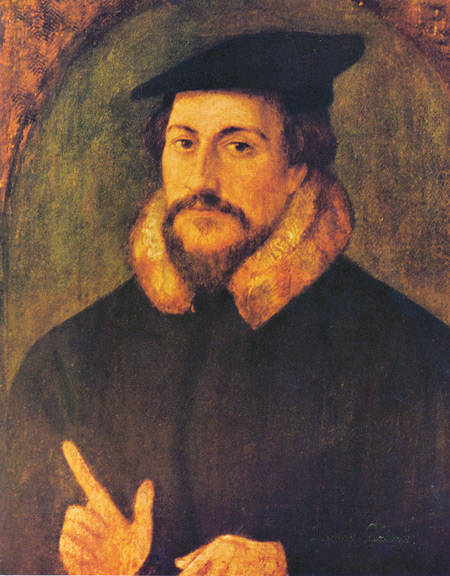 Hans Holbien's portrait of John Calvin, one of the founders modern Protestantism, circa 1550. Calvin, while perhaps more influential in the history of Protestantism than even Martin Luther, held several beliefs that were distinctively "Catholic."
5. Calvin accepted the notion of baptismal regeneration: “... forgiveness, which at our first regeneration we receive by baptism alone ... we are washed from our sins by the blood of Christ.” (IV, 15:4)
4. Calvin approved of bodily mortification as spiritually beneficial: “In like manner, therefore, as persons accused were anciently wont, ... to humble themselves suppliantly with ... coarse garments, ... weeping and fasting, and the like, undoubtedly belong, in an equal degree, to our age, whenever the condition of our affairs so requires.” (IV, 12:17)
3. Calvin believed there was a profound causal connection between Holy Eucharist and salvation: “Nay, the very flesh in which he resides he makes vivifying to us, that by partaking of it we may feed for immortality. ... by this food believers are reared to eternal life.” (IV, 17:8) / “... the food of eternal life.” (IV, 17:19) / “... secures the immortality of our flesh, ...” (IV, 17:32)
2. Calvin held that contraception was gravely sinful: “It is a horrible thing to pour out seed besides the intercourse of man and woman. Deliberately avoiding the intercourse, so that the seed drops on the ground, is double horrible. For this means that one quenches the hope of his family, and kills the son, which could be expected, before he is born. This wickedness is now as severely as is possible condemned by the Spirit, through Moses, that Onan, as it were, through a violent and untimely birth, tore away the seed of his brother out the womb, and as cruel as shamefully has thrown on the earth. Moreover he thus has, as much as was in his power, tried to destroy a part of the human race. When a woman in some way drives away the seed out the womb, through aids, then this is rightly seen as an unforgivable crime.” (Commentary on Genesis [38:10], translated by John King)
1. Calvin accepted the Catholic and scriptural belief of the perpetual virginity of Mary: “[On Matthew 1:25:] The inference he [Helvidius] drew from it was, that Mary remained a virgin no longer than till her first birth, and that afterwards she had other children by her husband ... No just and well-grounded inference can be drawn from these words ... as to what took place after the birth of Christ. He is called ‘first-born’; but it is for the sole purpose of informing us that he was born of a virgin ... What took place afterwards the historian does not inform us ... No man will obstinately keep up the argument, except from an extreme fondness for disputation.” (Harmony of Matthew, Mark & Luke, Geneva, 1562, Vol. I, p. 107; from Calvin’s Commentaries, translated by William Pringle, Grand Rapids, Michigan: Eerdmans, 1949)
Dave Armstrong has been a full-time Catholic apologist since 2001. He lives in Allen Park, grew up in Detroit, and attends St. Joseph Church near downtown. He has been happily married to his wife Judy since 1984, and they have four children. Dave has written 44 books on various apologetics topics, including five for Sophia Institute Press, and several bestsellers in the field. These are available for purchase (ePub, mobi, or PDF) at his deep discount book site, www.biblicalcatholicism.com, and in paperback elsewhere.