

Longbeard CEO Matthew Harvey Sanders speaks to southeast Michigan Legatus chapters about Church's role in technology
TROY — Catholic business leaders need to understand the implications artificial intelligence will have on the workplace and the need to balance technological advancement with the common good of workers, one of the world's foremost Catholic AI experts told local Catholic business leaders.
Matthew Harvey Sanders, CEO of Longbeard, the world’s first Catholic AI forum, spoke Oct. 22 during a Legatus event at Petruzzello’s in Troy, telling a roomful of entrepreneurs, executives and business leaders that artificial intelligence will reshape the paradigm of work and human labor in the years to come.
In his keynote address, “Where is AI Today: Implications for Business, World and Faith,” Sanders cited some of the world's biggest AI companies' predictions that “the impact of artificial intelligence will be 10 times the impact of the industrial revolution and 10 times the speed.”
“To wrap our head around what that means, think about how the industrial revolution unfolded over the course of 150 years," Sanders said. "And now we’re saying this disruption will be 10 times that impact. That’s why tonight matters. For those of you who have kids who are in high school or just starting college, I'm sure by the time they graduate, the world will be completely different from the world we inhabit now.”
Sanders spoke about how artificial intelligence differs from human intelligence and how the pace of advanced computing will progress exponentially in the next decade.
“We are approaching a level of artificial intelligence in the next 10 years that will surpass all of human thinking capacity,” Sanders said. “And we keep getting faster at this because we can use artificial intelligence to help accelerate the development of better artificial intelligence. Today’s advanced code is written by AI.”
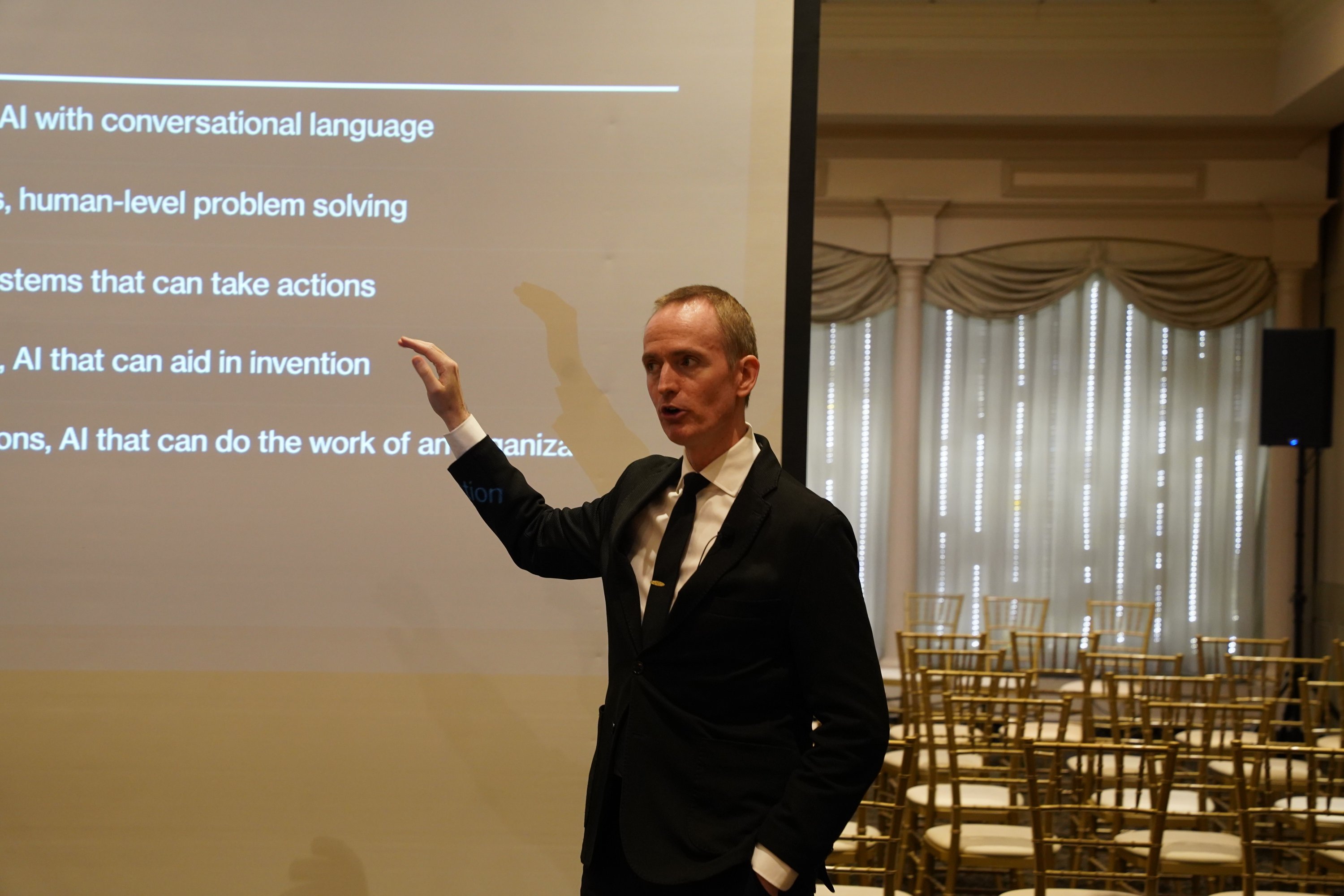
Sanders pointed to technological advancement in recent decades that has seen computers shrink from once being the size of buildings to being able to fit inside a smartphone. To illustrate his point, Sanders pointed out that in May 1997, IBM's Deep Blue and its giant computer servers defeated chess grand champion Garry Kasparov, but today, the AI chess app Stockfish can regularly defeat modern chess grandmaster Magnus Carlsen.
Sanders warned that these advancements in artificial intelligence and supercomputing are leading to a world where business leaders worried about profit margins will increasingly look toward machines to complete tasks rather than human beings, causing great disruptions in blue-collar and white-collar industries.
“This isn't too far away,” Sanders said. “We'll likely get to (artificial general intelligence) before we have robots running around in our homes, but it's coming. And when it does, that's when blue-collar workers will start realizing that their jobs are now threatened, and that could be very scary for a lot of people.”
With tech entrepreneurs pushing for greater advancements in artificial intelligence and robotic design — and many in Silicon Valley subscribing to ideas centered in transhumanism and the mending of man with machine — Sanders said now is the time for the Catholic Church to speak with a prophetic voice on the truth of what it means to be created in God’s image.
“It’s very important for the Catholic Church to succeed in its evangelization mission,” Sanders said. “And, if for no other reason, (it's because of) our vision of the human person. The toolkit the Church has for building a meaningful life, a purposeful life, and our vision of the human person is important. Because the vision of a lot of people in Silicon Valley is very different for what the future of humanity should look like.”
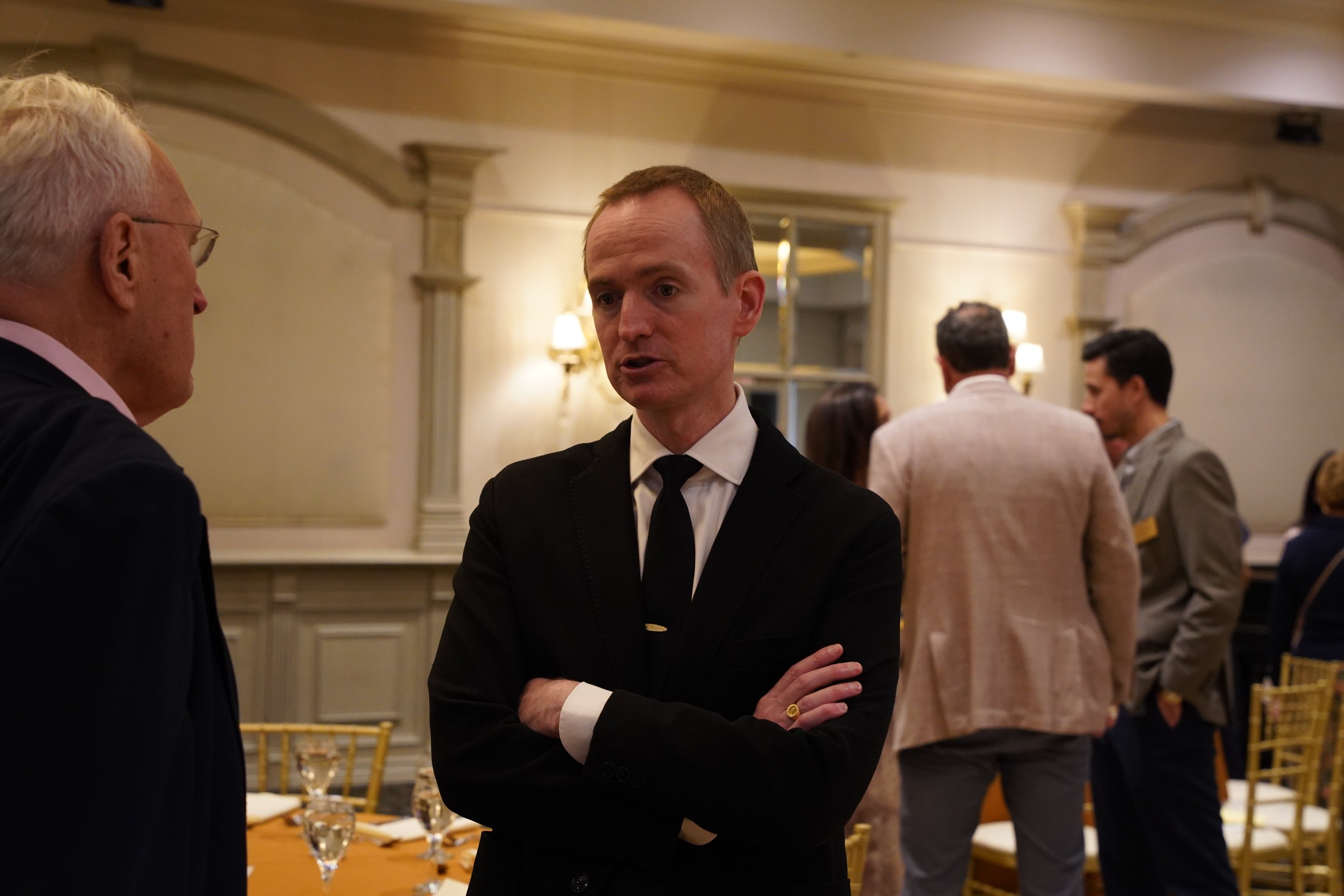
Sanders highlighted particular themes in Pope Leo XIV’s recent encyclical, Magnifica Humanitas, about the human need for community and connection that transcends what one can contribute in a consumerist economy.
Sanders said artificial intelligence runs the risk of further alienating people from one another as societal bonds fray, especially given the specter of widespread job losses.
“There's a real risk, like in COVID, that people will just end up turning to distraction, unable to answer the big questions that are now they're confronted with: ‘Who am I? and ‘Why do I matter?” Sanders said.
The Catholic Church can play an important role in the conversation about artificial intelligence by reminding people why they uniquely matter, Sanders said.
“I think the golden path is basically where we take what we know about the human condition, and we try to intentionally build a community in the future in which human flourishing from a Catholic perspective is the focus, and everything is organized around that,” Sanders said. “It's hard for us to imagine that world, but I'm sure it looks a lot more like medieval villages than these huge cities we built to serve industrialization, where people are known and can be known, where everyone feels a sense of purpose.”
Artificial intelligence doesn't have to replace humanity, Sanders said, and there can be legitimate hope that it will help re-orient people and communities beyond what is most productive, and toward what provides the most fulfillment.
In other words, a world where artificial intelligence is designed to serve — rather than supplant — humanity and its pursuit of communion with God and neighbor.
“It's about finding that proper scale for an optimal human life,” Sanders said. “We know the robots will be there, the technology will be there in this world we build. But hopefully, we will have discerned what truly matters, what really gives us human flourishing. What are the areas in life we leave to ourselves so we can make a contribution to a healthy, happy society?”